

Let's write love poems—ones that are messy and authentic, poems that declare HEY I LOVE YOU in a way that feels fresh and new. And we'll do it with the best of guides, contemporary poets that showcase what's possible to write when we write about love. Here's 7 tips to get you started.
1. Be wary of clichés and overused romantic imagery.
One great way to do this is to take a minute and list what first comes to mind when you think of love. Red roses. Flowers in bloom. Lovers holding one another. Getting butterflies, blushing. Walks at sunset. A kiss. What happens when you write a poem that doesn’t incorporate these top-of-mind thoughts? And instead, what would you never expect in a love poem—a tractor beam or a budget or a sinkhole—and how might that unusualness make it more authentic and memorable?
Sometimes I'll even purge the clichés out of my system. I write the 'bad poem' first:
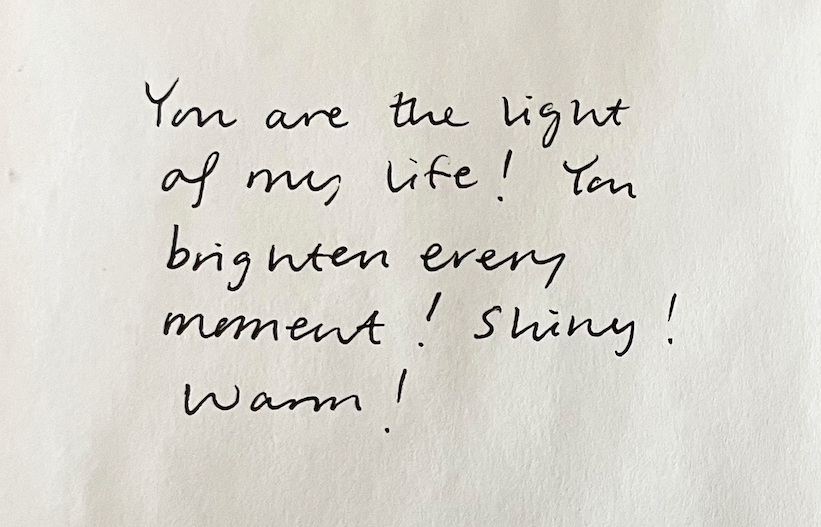
You are the light of my life! You brighten every moment! Shiny! Warm!
Then, I like to take the cliché as a challenge—what if I write a poem called "Light of my life" that brings in the weirdest light imagery I can imagine? And what if it still acts like a love poem?
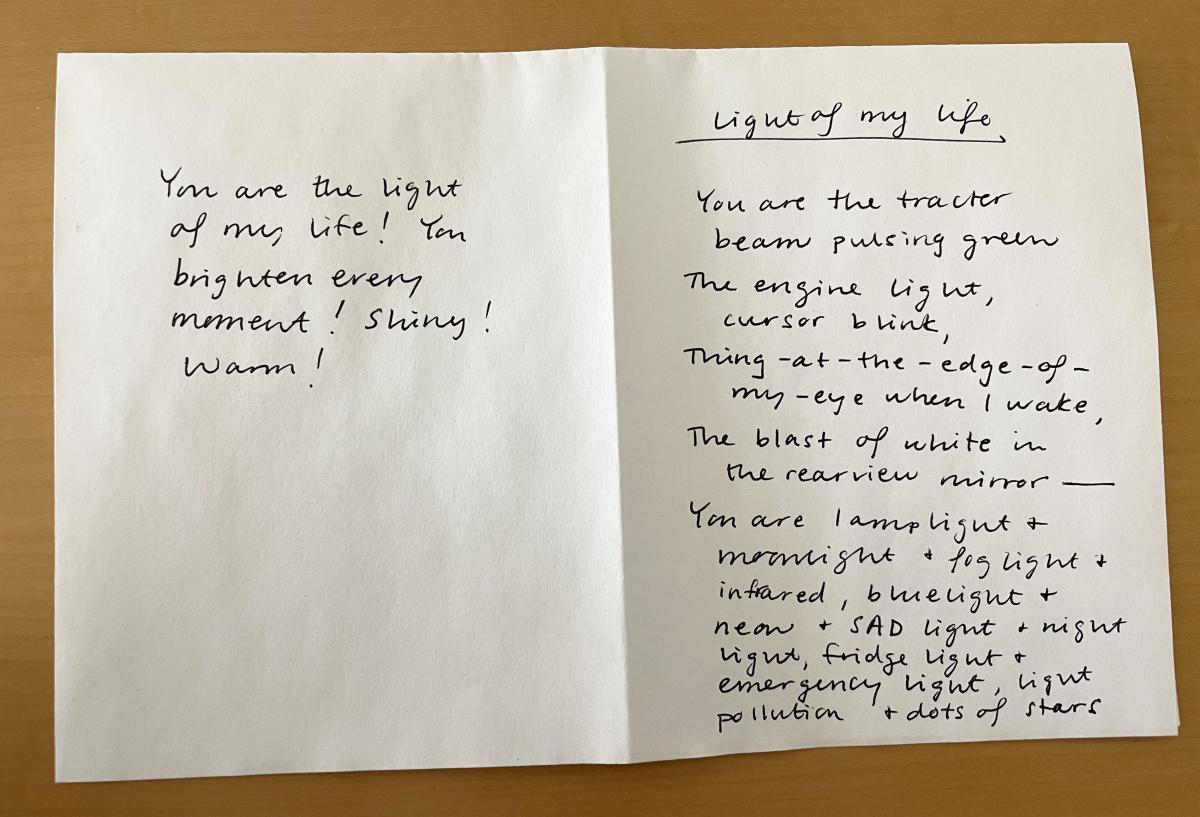
The new poem reads:
You are the tractor beam pulsing green,
the engine light, cursor blink,
thing-at-the-edge-of-my-eye when I wake,
the blast of white in the rearview mirror—
you are lamplight & moonlight & foglight &
infrared, bluelight & neon & SAD light & night
light, fridge light & emergency light, light
pollution & dots of stars.
If you want to see an entire poem that where each metaphor is more of a surprise than the next, Camille Guthrie's poem “My Boyfriend” is a full inventory of the beloved, inside and out:
cheeks like party invitations
jaws like handcuffs
teeth like sweet tea
a tongue like watercolors
a mouth like a silk lampshade
a face like a moving picture
a head like a jar of pennies
a skull like a geode
The poem as a whole is so bizarrely specific, and the quick succession of metaphors makes the poem rush forward, a runaway-train. And doesn't love feel that way, too? Like nothing makes sense or even has to, like everything you've ever loved for any reason is just swept up in the beloved.
2. Challenge how a love poem 'behaves.'
However a love poem is expected to behave—what if it didn’t behave that way?
For instance, many of us think of love poems as monologues to the beloved. But what if the poem were instructions, like when Li-Young Lee writes in “I Loved You Before I Was Born”: “I give you my blank heart. Please write on it what you wish.” (Sigh).

Listen to "I Loved You Before I Was Born" on voca
Or even more brazen—what about starting a love poem with an insult? Marvin Bell opens his poem “To Dorothy”: “You are not beautiful, exactly./ You are beautiful, inexactly,” and the surprise of swiveling from such audacity to a weird sort of sweetness makes the poem strikingly original, if a bit punchy.
What if a love poem behaved almost like a prayer? Natalie Diaz opens "These Hands, If Not Gods" with an almost trembling kind of love: “Haven't they moved like rivers, like glory, like light over the seven days of your body.” I can’t help but be reminded of creation metaphors (And on the seventh day…) and words of worship ("like glory"), underscoring the behavior of the poem-as-prayer, submerged in a tone of absolute awe.
3.Get messy, emotionally.
One reason many love poems fall flat is because they are determined to be adoring—and nothing else. The risk? Such poems tend to feel one-note or even trite. But love, like life, can be grimy or grief-riddled, funny or awkward or anxious. So allow the emotionality of your poem to be multidimensional.
For instance, Aimee Nezhukumatathil’s "Naming the Heartbeats" plays with our expectation of a sappy love poem and spins it on its head when she writes: “I have become the person who says ‘darling,’ who says ‘sugar pie,’ ‘honey bunch,’ ‘snuggle bear,’ and that's just for my children. What I call my husband is unprintable. You're welcome.” Suddenly the poem ALMOST becomes graphic—and then it doesn’t. And it’s hilarious.

Listen to "Naming the heartbeats" on voca
Kim Addonizio gets so messy she doesn’t even complete a thought in her poem, “My Heart,” instead writing a series of fragments attempting to unravel what her own heart feels like, from a “chicken shack” to a “kiosk at the mall selling caramels and kitsch.” The poem is flustered and raucous and messy—as love sometimes is.
Mess can even mean introducing sorrow or despair into the love poem. In fact, you might consider the elegy a kind of love poem, wrapped tight in grief, like Mary Jo Bang’s “You Were You Are Elegy,” which ends beautifully with: “You were. You are/ The brightest thing in the shop window/ And the most beautiful seldom I ever saw.”
What would happen if you wrote a furious love poem? Or a poem where love feels like drowning? A love poem studded with thumb-tacks or that's been resuscitated on the side of the road?
The poet Adrian Blevins noted that, "The problem with love poetry is that it must be felt and written by humans, who never feel one feeling at a time." But maybe that's an asset—we don't ONLY love the beloved. There's something else there, too.
Let it in.
4. Write a poem that could not possibly be for someone else.
Your love poem is for a particular beloved, so get specific! Create a collage of particularities. Incorporate the detritus of your lives, concrete things, pop culture, nods to your own lexicon, rituals, or memories—include the building blocks of your universe, at this particular moment in time. (And try to be as tactile as possible, using your five senses, to ground your poem.)

Listen to "love poem with apologies for my appearance" on voca
Ada Limón does this beautifully in “Love Poem with Apologies for My Appearance.” She writes: “Sometimes, I think you get the worst of me. [...] the stained white cotton T-shirt, the tears, pistachio shells, the mess of orange peels on my desk.” Her poem is a snapshot of a moment in time, an intimate, particular portrait of the world she shares with the beloved. Even the title sheds light on the kind of relationship she shares with the beloved, that she’s a little embarrassed (and good-humored) by her own disheveled-ness.
What if you wrote a "Love Poem with Sinus Problems" or a "Love Poem with Alternate Route due to Multiple-Car Pileup"? A "Throwaway Love Poem for Obvious Reasons" or a "Poem in Which the Poet Ventriloquizes the Beloved"? What would that poem look like?
5. Sometimes less is more.
Some of the most impactful lines in love poems are the simplest. Li-Young Lee is a master of this: “I loved you before I was born. It doesn’t make sense, I know.”
Or this charming line from Joseph Legaspi’s “Vows (for a gay wedding)”: “When you're summer, I'm watermelon balled up in a sky-blue bowl.” You often don’t need the grandiose to express love—instead you can ask yourself what’s in reach? What’s here, and real?

Listen to "vows (for a gay wedding)" on voca
6. Remember a poem is a collaboration between the writer and the reader.
This means that poems are often most impactful when the language on the page provokes a response—imaginatively or emotionally—in the reader. Think of Pablo Neruda’s famous line, “I want to do with you what spring does with the cherry trees.” He could have further described what he means, about the trees bursting into bloom, etc., but instead he lets the reader complete the image in their own mind, and that trust—of passing the poem to the reader and letting them finish it—is not unlike love. Someone kisses you, you get to kiss them back.
7. A poem is a gift, not a snare.
Love poems are not spells you cast to make someone love you; a love poem is simply a gift to the someone you love. There should be nothing expected in return.
For even more inspiration, check out some of our favorite poetry recordings of love poems on Voca.