
Write down to the bone: go to the roots of things,
look up the meaning of words, where they come from,
come to the point where you understand what supports it.
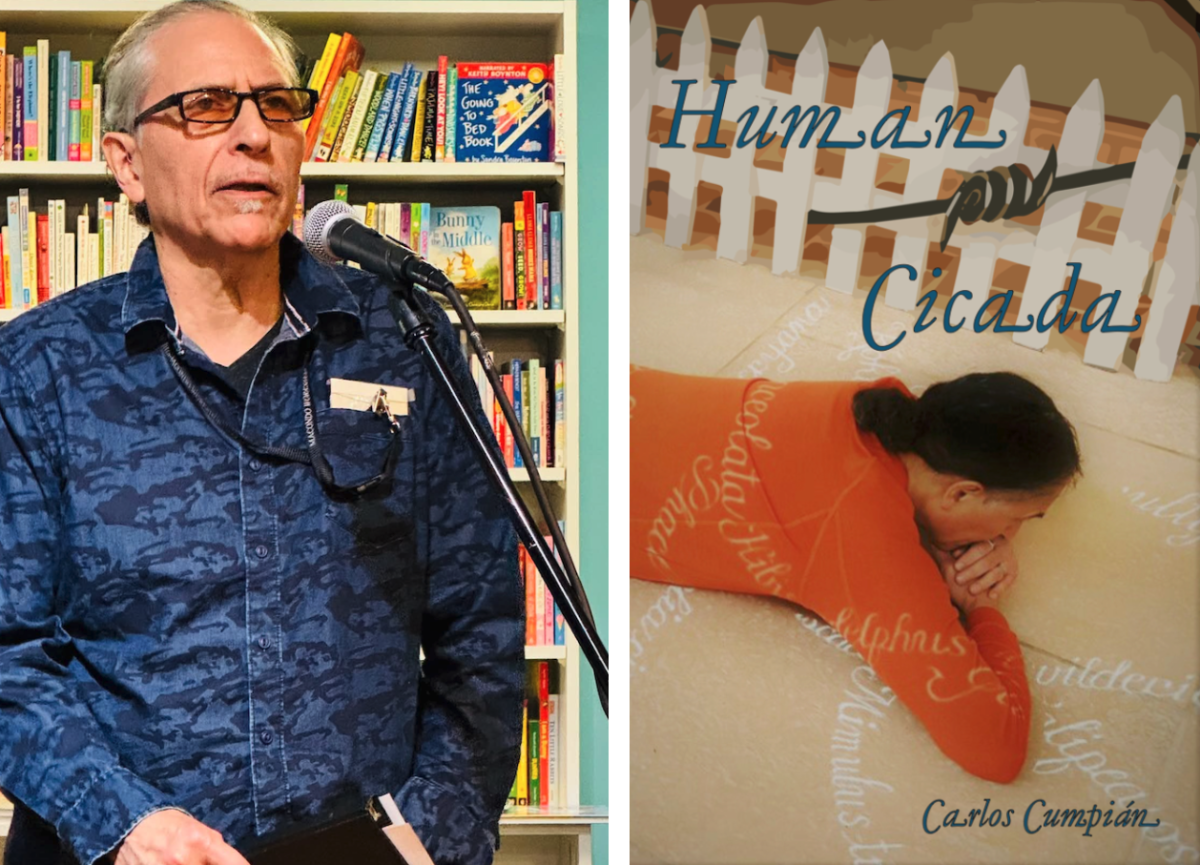
Carlos Cumpián is a Chicagoan with Coahuiltecan roots. His most recent book is Human Cicada (Prickly Pear Publishing, 2022). Other titles are Armadillo Charm (Tia Chucha Press, 1996), the award-winning Latino Rainbow (Children's Press Scholastic Books, 1994), and Coyote Sun (1990). Cumpián has been included in over thirty anthologies, most recently in Shoulders Gathered by The Waters Anthology (The Poetry Movement, Chicago-Racine 2025). Cumpián cofounded March Abrazo Press with William Oandasan, the first small press in Illinois whose mission continues to be publishing poetry or literary criticism about Chicano, Mexican, Latinas, and Native American Indians. He was a 2025 honoree of The Instituto Cervantes and DePaul University’s Spanish Department for his publishing and promoting poetry in Spanish by Chicago’s poets.
______________________________________________________________________________
Angelica Flores: Thank you for agreeing to this interview, Carlos! After reading Human Cicada (2022), Coyote Sun (1990),and some of your most recent poems that have been published, I’m curious about your journey that led you to poetry. When did you find out you were a poet, or knew you wanted to dedicate your time to writing poetry? Did you ever explore other genres?
Carlos Cumpián: Angelica, gracias, thank you for asking me to do this. I was fifteen back in 1968 when my initial interest in trying to write my own poems happened. This wasn’t a classroom assignment; it was because of girlfriend Sandie Balas. She enjoyed poetry and wrote her own. I started reading poetry, so I might learn what makes a good poem. I knew a few older students who read their poems at a Friday night “Youth Coffee House” associated with a Presbyterian Church on Chicago’s far southside. These student “hippies” even came up with a mimeographed, stapled four-page art and poetry “zine” called The Pullman Mother.
My contribution was a cartoonish psychedelic “long hair” male for one issue’s cover. It was a time when guys wearing their hair past their shirt collars would provoke the “jocks” and some “greasers” in attacking us verbally and physically for being “freaks.” If a guy liked poetry, he was considered “queer.” My poetry role models were “The Beats”: Allen Ginsberg, Lawrence Ferlinghetti, Gregory Corso, Diane Di Prima, Gary Snyder, and the San Francisco’s City Lights Pocket Poets Series authors. The anti-war revolutionary or leftist press also carried a fair sample of poetry back in the late 1960s.
I also read Big Table Books. The Romanian writer and immigrant Andrei Cordescu was the first bilingual poet I read in his classic 1970 book, “The License to Carry a Gun.” He assumed the persona of a jailed blind Black Puerto Rican as one of his characters. The first Chicano poet I ever read was in an anthology called Poets of Today: A New American Anthology (International Publishers, 1964); it was here I discovered the great artist and labor activist Carlos Cortez.
We would eventually meet in 1973 and become close friends for nearly 40 years. I also published his second book, De Kansas a Califas & back to Chicago (March Abrazo Press, 1992) and posthumously celebrated book Coyote’s Song: The Collected Poems and Selected Art of Carlos Cortez Koyokuikatl (March Abrazo Press, 2023). I was also a member of a South Chicago Mexican group of singers and actors called El Teatro Del Barrio, we traveled around in the years 1974-1977. In the early 2000s, I wrote a play which had a staged reading in Jamestown, New York which was about the Buffalo Bill Wild West Shows. Other writings are various essays I’ve written about literacy among Mexican Americans and the history and prospects for a successful Chicano small press at the turn of the century. See my work, in the anthology With a Book in Their Hands: Chicano/a Readers and Readerships Across the Centuries (University of New Mexico Press, 2004). Also, in 1999–the Los Angeles -based publication RATTLE gave me ample space for my essay on the Latina/o Chicano/a small press entitled, Without Reservation or Passport, The Next Round Is Ours.
Some of my favorite poems were the ones with your grandmother, like “Fronterizo Shopping Trip” and “Nuestro Día con Doña Jesusa.” In Fronterizo, there’s a revelation where you and your cousin find out that your grandmother actually spoke English, but what stood out to me the most in the poem was your grandmother outsmarting the border agent. Nostalgia is a way of archiving memories.
I admit, there’s a prose quality to the poem Fronterizo Shopping Trip, but ultimately it was conceived as a poem—I do tell a story, but not as in-depth as it would be in a work of fiction or a total autobiographical account. I do a fair share of narrative poetry as well as lyrical; if you review my book’s opening poems, they’ll be more “traditional” appeals to the five senses.
Is your poem, O José, Can you see? a response to José Olivarez’s Mexican Heaven? Mexicans never know when El Popo is gonna fully erupt; who knows if it will happen in our lifetime. Since José wrote about Mexican heaven and you wrote about an American hell, I think that leaves me to write a poem about Mexican-American purgatory.
Bingo! Go for it. Yes, if you know, you know. How about the cartels warring with each other and the government of Mexico? Somewhere there’s a dirty party inside the USA, making hell for Mexico and the USA. We are “connected,” don’t you agree? José is a great talent.
We certainly are. After all, many U.S. states used to belong to Mexico. Your poem, “Beauty and the Blade,” was inspired by one of your past students at Roberto Clemente High School. I think you did a great job capturing what it’s like to work with teens. Tell me about your experience working in schools.
Thank you for the compliment on the poem. I’ve read that many public school teachers quit after burnout in a five-to six-year period. Why? There’s plenty of DRAMA and pathos and bathos in most big city high schools, I suspect. I had all kinds during my 25 years as a teacher. Some were homeless, some lived in poorly ventilated and unheated basements, many were malnourished, many were the children of gang-connected families. While I also had some who were from highly successful small business families in the restaurant, car repair, or home remodeling fields. I know many students never took steps beyond high school for higher education degrees. But some certainly did, and today are professionals or independent business folks. My core goal with all of my students was for them to find pleasure in reading and reflecting on meanings. I loved teaching and workshopping poems, which was always something I looked forward to doing.
One poem that I really enjoyed was the “Singing Chihuahua” poem about your tia and tio’s chihuahua, Pepito, who dances and sings when instructed. I was fascinated by how you described Pepito’s eyes: “quizzical, big dark eyes.” I couldn’t have described it better. This poem reminds readers that you observe and think animals are worth writing about, and it reminds me of your collection titles: Human Cicada, Armadillo Charm, Coyote Sun.
The choice isn’t between animals like a coyote and an armadillo, but cicadas are not celebrated or cared for like our four-legged relatives. Actually, my Texas family totem symbol is the armadillo—we are not really aggressive, nor do we wish to be hunted to extinction. We carry our homes on our backs; we ruck for survival. Please don’t run us over; slow down for the four-legged nations.
Speaking of survival, I was intrigued by your persona poem, “Haiti (2010)”. You wrote this poem from the point of view of Darlene Etienne, a teenage girl who was rescued from the rubble fifteen days after the earthquake. I was shocked; it’s a miracle that she was alive. The persona approach worked because we read what she was thinking before the earthquake and after it, while she was stuck under the rubble. Do you know if she’s aware that you wrote this poem about her?
I honestly was impressed with her resilience to stay alive after being buried in the rubble. These are modern miracles. I never wrote or spoke with this young woman before or after this traumatic event. I pray she is still alive and doing well. Today, the people of Caracas, Venezuela, are dealing with similar traumatic conditions.
Now, I would like to move on to one of your most recent poems, which also happens to be a persona poem! “Shawnee Leader TECUMSEH (1768-1813),” a poem that is featured in a new anthology, Poets Respond to the American Revolution: The US250 Persona Poem Project. Out of all the figures that participated in the American Revolution, why did you choose to write about Tecumseh? What do you think Americans can learn from him?
Angelica, think about how marginal the literary canon is regarding American Indian Native voices. Just consider the mythical quality of the founding or of the "incorporation" of the business we know as the United States of America; few consider American indigenous Indians having a role in that process. I chose Tecumseh because he was a patriot of this land before the Europeans gained control over its resources.
I’m glad I learned about Tecumseh through your poem. I would like to switch gears and talk about writing. What advice do you have for adult writers who struggle with writer’s block or with setting up a routine to make sure they are writing regularly?
Not to spend too much time on social media, rather talk to people directly from all walks of life and READ everything, especially on topics you KNOW nothing about! Be curious and patient with yourself. Build a schedule you can keep for writing. Scan your zone: know what’s going on around you. Know your home: read about the history of your roots and where you live. Write down to the bone: go to the roots of things, look up the meaning of words, where they come from, come to the point where you understand what supports it. Be ready to edit the whole poem over and over. Then leave it. Share but don’t expect praise. Have multiple dictionaries, send out at least one poem every six weeks, and every six months if you are lazy. Self-publishing isn’t a sin, but it can be ugly, and A.I. isn’t going to win you awards if people find out it was you as a co-author. Read about the 20th- and 21st-century trailblazers! Don’t let a week go past without learning one new word!
This is great advice! You currently run the small press, MARCH/Abrazo Press, which has been running for more than thirty years. What advice would you give to someone who wants to own a small press?
It may be just the craziest thing someone could offer to do, editing and publishing others when the person you are going to put into print, for example, has no interest in making any effort in promoting their book, or if they do, it’s limited to their relatives, and otherwise they think public appearances are worthless. I have published people like that, only to find out later that this was their attitude. Then, to top it off, they feel you should be spending more money promoting them or buying ad space in newspapers or trade publications when all they have are, on average, three books a month being sold. It is a lot of fun to learn the ropes of publishing, and if that is your passion, I say pick your people carefully, but do it, and have a contract that spells out everyone’s role for at least two years.
How do you think the literary scene has evolved for Latine and Chicano/a writers in Chicago and in the U.S.?
Nationally, the word Latino/a/x or the Latine scene is very academic. It’s rather a campus hot-house creation—in part, that’s why people are seeking MFAs in poetry. The majority of the readers who appeared at the 1991 two-day Nezahualcóyotl Poetry Festival I coordinated had no college degrees, at least no MFAs in literature, which is true, I think, still for the Chicana/o poets publishing books.
If there’s a way to make poems “pop” with sound effects or music, there will be someone trying to escape having to commit to the printed page, but the printed page, as “old-fashioned” as it may appear, will be around after the electrical grid is down. I think Chicano poet Pablo Ramirez’s new book, Pocho Love, with its kaleidoscope of designs and color and super-easy-to-read large-print poetry, is part of the Japanese MANGA influence on the graphic novel. It has also become a bestseller with our March Abrazo Press! The disadvantage is that bookstores are reluctant to carry over size books-so proceed with caution.
The scene is always changing if you track who has “retired” from their beatnik sojourn as the poet, and I know many people needed to get serious about raising families and careers and didn’t have time for the least prostituted of the arts—poetry. I should state the obvious–computers and the web makes for some great out reach–it looks like ANYONE can do their poem and post it online. That is happening and maybe COVID’s restrictions also sped up people Zoom-ing their work for an audience that was separated.
You and your poet wife, Cynthia Gallaher, are one of the top ten requested poets in Chicago Public Libraries. You two are the only literary couple on that list. If I may ask, how have your writing lives influenced each other over the years?
We are each other’s first reader/listener, and we offer honest criticism in a loving manner (most of the time). We learn from each other and offer suggestions when needed. Keep a beginner’s mind, and it adds to the relationship’s durability.
Thank you, Carlos! Carlos Cumpian’s new chapbook, Road Spider, is forthcoming and hopefully will be available as early as October 2026.
__________________
Angelica Flores is a Mexican-American writer who lives in Chicago, IL. You can find her book reviews in Newcity’s magazine and website. Her poem was recently featured in the exhibit "1000 Words | Home Not Home" at Pilsen Arts & Community House. You can follow her on Instagram:@writerangelicaflores.