

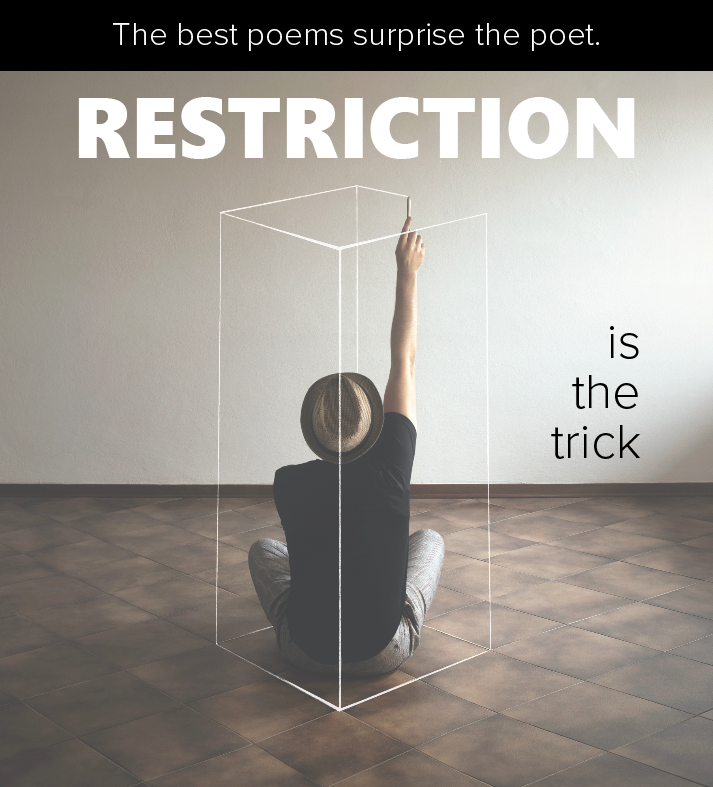
Often, the harder the challenge, the more rewarding the end result.
If you ever want to baffle a poet, just ask them to define poetry. There’s a thousand ways to label the genre, none of them satisfying or complete. My own attempt changes all the time, but for now I’ll use an example culled from a beloved TV sitcom. There’s an episode of The Office where lovable buffoon Kevin decides to streamline his communication and save energy. His solution? “Why use many words when few word do trick?”
Learning to ‘A Void’
Kevin, it turns out, is a genius; or at least a poet in disguise. For me poetry is communication condensed, stripped of what is superfluous until the words that remain shine like opals, washed clean of mud.
A lofty goal, but how do you actually make those jewels shine? Kevin’s example shows us that setting yourself an arbitrary, left-field, challenge is a solid way to start. And virtuoso examples are everywhere. In 1969, George Perec, French author and subject of the hairiest author’s photo ever, published a doozy of a book. Titled La Disparicion, or to use its English translation, A Void, it was a 300-page story driven by the harshest of restrictive challenges: Perec had written an entire novel without using the letter ‘e’. The result is weird, rhythmically uneven — and totally thrilling; an utterly unique story that only existed because Perec tossed a whole letter out of his toolbox.
For me poetry is communication condensed, stripped of what is superfluous
until the words that remain shine like opals, washed clean of mud.
As a sometime poet still finding their feet, if ever I’m stuck in a creative cul-de-sac, halfway through a piece, or unable to even start, I ask how I can restrict my own pallet. Far from hobbling me, it feels oddly freeing. Why? Because it rewires your brain, jolts you awake and forces you to solve a clear challenge. One of my challenges was to write a love poem without using any language of love whatsoever — no hearts aching, no sweaty yearning kiss, no comparing thee to a summer’s day.
Instead I drew inspiration from a fact I’d learned while idly doomscrolling, and couldn’t get out of my head. The fact: soldiers often leave coins on the gravestones of dead comrades, a tangible ‘language’ that quietly speaks of their respect and admiration. A haunting image, and one that allowed me unpack how I feel about my wife in ways I’d never expected. Instead of hackneyed, rose-bloated imagery, I wrote about bawling drill sergeants, and the grim reaper’s clammy hand. The result is one of the pieces I am proudest of, now published in Rattle, compared to the literally hundreds of lukewarm poems I’d written before.
I ask how I can restrict my own pallet.
Far from hobbling me, it feels oddly freeing.
Amen to Finicky Forms
Looking for other ways to stumble into creativity? Try tackling a traditional form you’re not used to. Haiku, with its sparse handful of words and syllables, is the definition of playful restriction. A villanelle’s recurrent refrain forces you to create a line that can echo in different ways every stanza. Concrete poems encourage us to mold meaning into shape, literally.
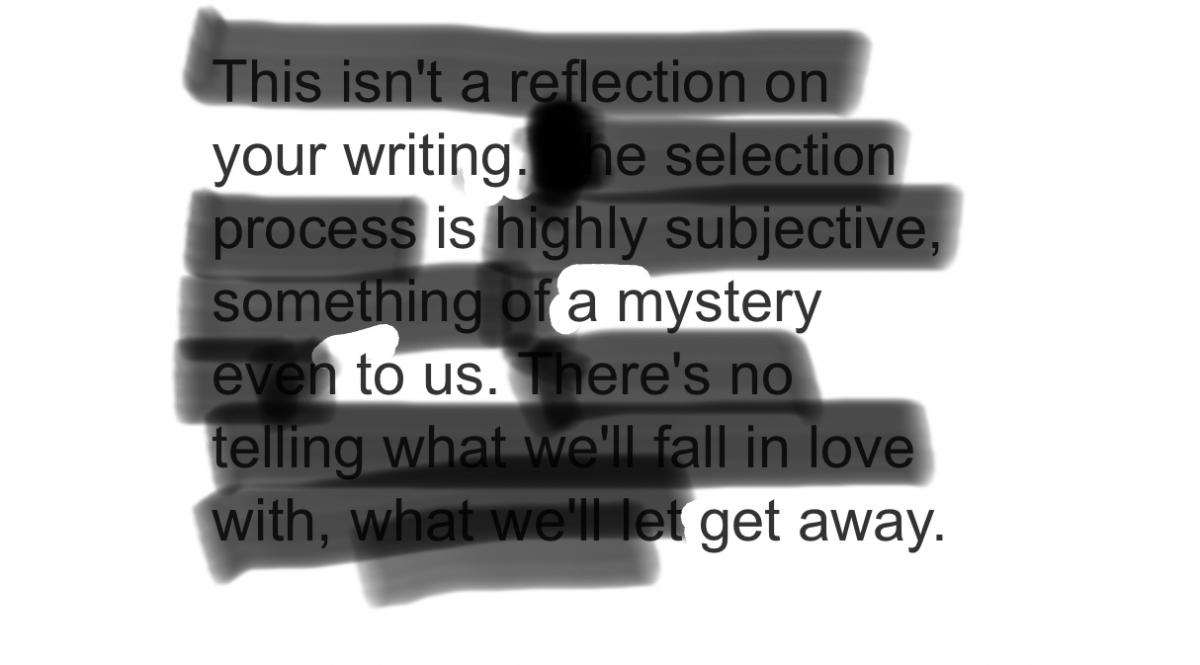
And in a world where rejection letters tumble ever-easier into our inboxes, poets are learning to twist dismissals into found art. By blacking out strategic words, erasure poetry becomes playful, layered and mightily cathartic, as R.L. Maizes shows us with her piece, titled ‘RE: [YOUR SUBMISSION] (spoiler alert, the news is bad)’.
Have a look at how she alchemizes the original rejection letter into that familiar twist of the knife every writer feels when a piece gets spurned:
This isn’t a reflection on
your writing. The selection
process is highly subjective,
something of a mystery
even to us. There’s no
telling what we’ll fall in love
with, what we’ll let get away.
The full text above, carefully blacked out, becomes:
One more example before we end: Jeffrey McDaniel’s ‘The Quiet World’, which spotlights the theme of constraint as a plot device that powers the poem from the get-go, imagining a world where our very words are curtailed to ‘exactly one hundred / and sixty-seven words, per day.’ In four pin-perfect stanzas, McDaniel’s draws us ever-closer in, from the mime-play of ordering food (‘I point at chicken noodle soup.’) to a call with a lover, where he will ‘proudly say I only used fifty-nine today. / I saved the rest for you.’
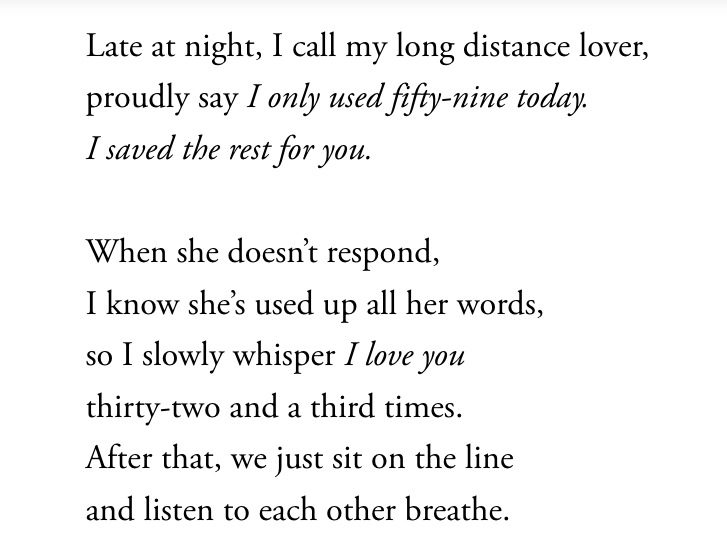
The last few lines — like the piece as a whole — help us recall that communication is at its heart a magical act; alchemy with the tongues. All because the poet painted an alternate reality where words become precious gems, restricted and rare: opals shining in the mud.
There exists, then, a universe of ways to close the circle of creativity tight around yourself. The fun is finding one that works for you. Often, the harder the challenge, the more rewarding the end result. Turns out that when you set yourself limits, it weirdly sets you free. Or as Kevin from The Office might say: try hard rule make good new thing.
________________________________________
Daniel Seifert's writing is published in The New York Times, Rattle, Terrain, and Poetry Wales. His fiction received a Special Mention in the Pushcart Prize 2026 anthology, and has twice been shortlisted for the Bridport Prize. He lives in Singapore, and tweets @DanSeifwrites.