

some things are so sublime that only the simplest,
most cursory telling is possible.
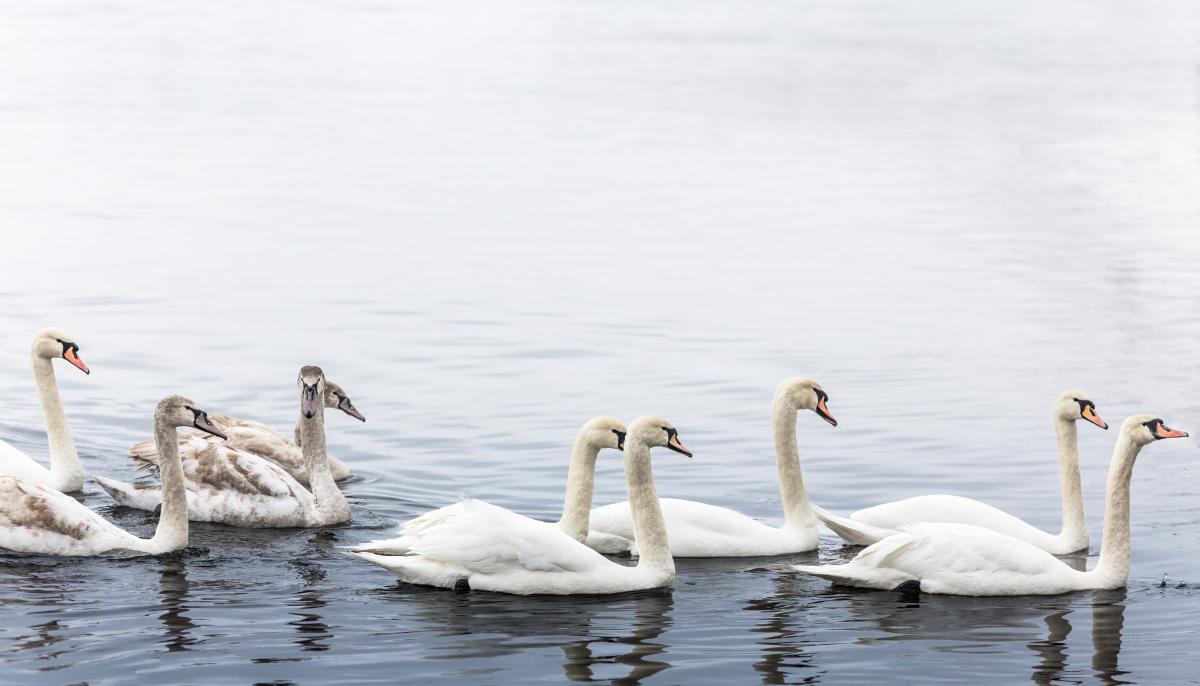
It’s understandable that plenty of young poets are warned against repetition: the discreteness of poetry, and the fact that a reader can theoretically hold the whole experience of a poem in their head (epic poems excluded), can make repetition seem like something to avoid. When used carefully, however, repetition can have a deeply powerful,almost incantatory effect, binding readers more tightly to the poem.
Consider, for example, Yeats’s poem “The Wild Swans at Coole.” In the first stanza, the word “water” appears twice in three lines:
Under the October twilight the water
Mirrors a still sky;
Upon the brimming water among the stones
Are nine-and-fifty swans.
We’ve just been shown an image of the water reflecting the moon, and there it is again, immediately: “the brimming water.” There’s an insistence here—don’t look away from the water yet, Yeats seems to say, because you haven’t yet noticed the swans. There is a similarly insistent use of vocabulary in the final stanzas also; the penultimate stanza, which describes the swans’ habitual mating rituals, concludes, “Passion or conquest, wander where they will, / Attend upon them still.” The first line of the next stanza repeats the adjective “still,” though with a different meaning: “But now they drift on the still water.”
What are we to make of this conspicuous reappearance? Is it perhaps that the poet is so enchanted, so fixed on the swans, that he is reduced to only a handful of words?
It’s worth noting that “still” functions in one stanza as adverb, the next as adjective. The longer we spend with the swans, the more words and their meanings seem to bend and sway. Yeats’ repetition here recalls Wordsworth’s description, in The Prelude, of the awesome mountain he spies from a nocturnal expedition on a lake in his youth: “a huge mountain, black and huge.” After we are returned to where we began, the water, all he can say about the swans is that they are “mysterious, beautiful.” Yeats’ poem is a wonderful example of how repetition can work, but it is also an example of when to leave behind the mantra “show, don’t tell”: some things are so sublime that only the simplest, most cursory telling is possible.
repetition is no failure of invention,
but a deliberate shaping of attention.

Listen: "to the mulberry tree"
Another way to think about repetition has less to do with vocabulary and more to do with insisting on a particular image or place. In Ross Gay’s poem, “to the mulberry tree” (which you can hear him read in the Voca archive), the eponymous tree becomes the center of the poem, the place from which the speaker will not let you, and perhaps himself, leave. The poem’s tone is initially comical, as Gay comes to know the fruit of the mulberry tree by way of a bird’s digestive system:
Everyone knows it’s good luck
if inconvenient
when a bird shits on you [...] I know that yes this shit
is mostly berry from
that most prolific of trees
After a detour in which he takes a swipe at those who deride the flavor of the humble mulberry, it is to the tree we return, but this time in a very different context, the sudden recollection of a memory:
be gentle
she said emerging from the dugout beneath the mulberry tree
where the big kids gathered
and we mostly rode our bikes by fast
so as not to be snatched to the ground and pummeled
or worse for they were teenagers.
It is the tree’s power—it is nature’s power—to snatch us from whatever diatribe we may be blazing and flood us with memory. The memory that the speaker recalls, initially full of the excitement and adventure of youth, portends something sinister: “and behind her beneath the tree / there was a filthy blanket / and a pack of cigarettes / and tinfoil wrappers crumpled and shimmering / and the frayed remnants of a rope.” It is a jarring image. Precisely because we receive no more information about the “frayed rope,” we have license to let our imaginations go to the darkest places. Another thing repetition can do is emphasize anything around it that has been left alone; we’ve been drawn back to the mulberry tree repeatedly, and suddenly Gay shows us this frayed rope, a new association with the tree, and says nothing more about it. That negative space, that lack appears larger and more sinister, precisely because he has given us so much previously.
Just as the mulberry tree triggers a powerful memory for the speaker, it also concludes the memory:
[she turned] my head away from what wreckage
waited in there
and back into the leaves,
which too I will do to you,
so that none of us will ever die terribly,
but stay always like this, lips and fingers blushed purple.
Whatever we might have seen and known from that vignette, we are now prohibited from knowing. Finally, Gay’s head is turned away from the rope and back to the tree, a final repetition. This is repetition as impediment, repetition as conclusion—some truths are too powerful or too painful to be told, and so they must be placed inside other things: strong and lasting and familiar things like mulberry trees.

Another poem that explores repetition as too-muchness is Jane Hirshfield’s “Mosses.” The speaker is taken aback by a fact she encounters reading the news:
For hypolithic mosses,
it seems,
four percent of daylight is right.
They live, the headline says,
by sheltering
under a parasol of translucent quartz.
It is the concept of “four percent of daylight” that amazes her, as she finds in it a comparison for our own species—might we, too, be as limited as these mosses that can bear only so much from the world?
Perhaps we, too, are mosses,
evolving to the parch
of our self-made Mojaves.
Unable to bear the full brightness,
the full seeing.
To recognize fully the Amazon burning,
the Arctic burning,
the Monarchs’ smoke-colored missing migration.
For the speaker, “full brightness” and “full seeing” are not necessarily desirable; they entail a reckoning with planetary destruction, with the “burning” of the Amazon and the Arctic, and our profound disruption of other life on the planet. It is the incomprehensibility of such seeing that leads the speaker, finally, to repeat herself, amazed, overwhelmed almost, by the thought of how limited our perception and how destructive our presence may be:
To the implausible green of existence,
for-better, for-worse,
we offered our four-percent portion of praises,
for-better, for-worse,
our four-percent portion of comprehension.
The poem begins with something learned—that the Mojave Desert’s hypolithic mosses need only four percent of daylight to live—and returns there. This is repetition as return to center, using the form of the poem to convey the primary conceit: humankind and a hypolithic moss might have something in common. Just as the moss cannot survive in any more than its meager four percent of daylight, the human race cannot conceive of a fuller, more understanding and compassionate means of living. The speaker reflects on smallness, and there is something small about repeating the same words, “for-better, for-worse,” “our four-percent portion,” as if by naming the miniscule realm that is our comprehension, we might just let in a sliver of daylight and thereby illuminate our world, just a little more.
Taken together, what these poems might say about repetition is that it’s no failure of invention, but a deliberate shaping of attention. It can insist, as in Yeats, that we remain with an image until it yields something deeper; it can return us, as in Gay, to a place freighted with memory, where what is unsaid gathers its own force; it can circle, as in Hirshfield, around an idea too large to be apprehended in a single pass. For poets, then, repetition is less about saying the same thing again than about saying it differently each time—in a different context, with a different weight attached to it. A repeated word or image is never identical to its previous appearance; it accrues meaning, and distorts perception. To write with repetition in mind is to recognise that poems do not move only forward but also deepen, that understanding often comes not through progression but through return.
_____________________
Ivan Kirwan-Taylor is a writer and former teacher based in London. He writes about literature, and the cultural life of cities. His work has appeared in Granta, The Times, Vittles, and The Cleveland Review. He has written two screenplays, and is currently working on a fiction project.