

revision is not always the uphill climb toward an ideal form.
Sometimes it is a fork in the road.
We encounter poems as finished things. Clean lines. Careful stanzas. A final period placed with quiet authority. On the page or screen, the poem appears inevitable, as if it arrived whole—carved in one piece from the marble of inspiration.
This is the myth, and it is persistent. But open a poetry archive—those boxes of papers, notebooks, and digital files poets leave behind—and the myth crumbles. What you find instead is uncertainty. Crossed-out words. Rhyme schemes abandoned mid-stanza. Margins filled with self-interrogation: Is it working? What if I try this?
This essay argues that poets’ drafts are not mere precursors to finished work. They are essential texts in their own right—sites of struggle, decision, and possibility. They remind us that craft is not the opposite of mess. It is what emerges from mess.
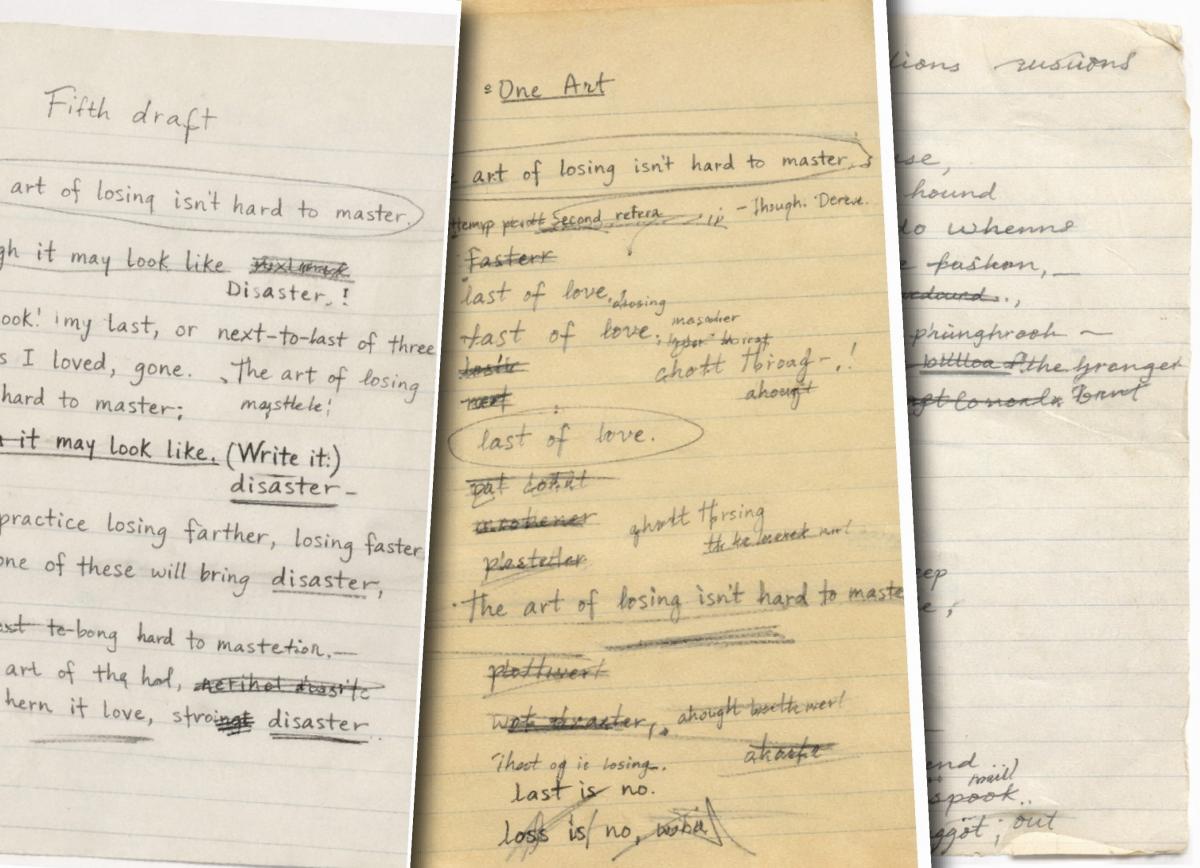
The Seventeen Drafts of “One Art”
Elizabeth Bishop’s “One Art” is among the most beloved villanelles in English. Its final couplet—“the art of losing’s not too hard to master/ though it may look like (Write it!) like disaster”—archives that rare thing: formal perfection that still sounds like speech, composure that cracks open at the precise moment it must.
But the poem did not begin this way.
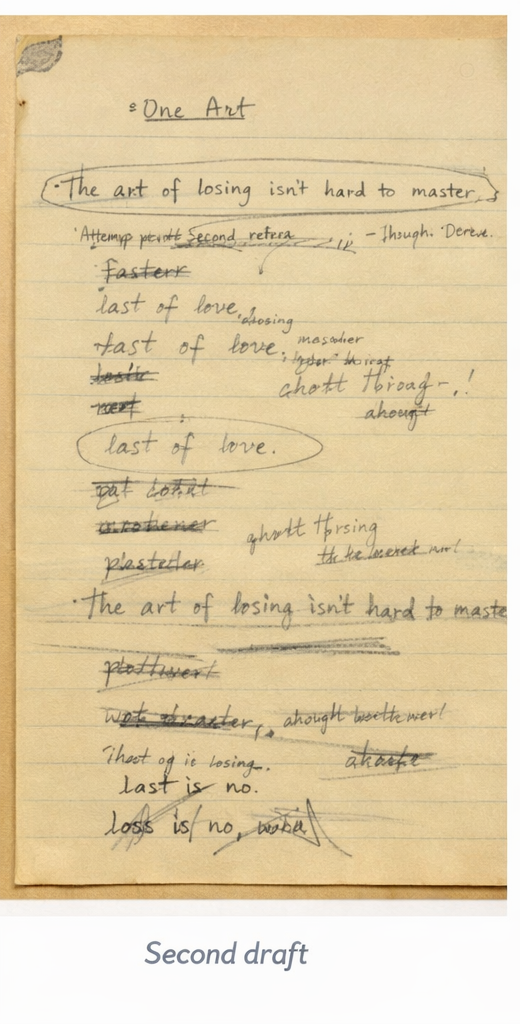
though the rhyme for “master” has not yet settled. Structure begins to discipline the earlier expansiveness.
Bishop’s drafts, held at Vassar College, tell a different story. The earliest version exists as prose notes. She knows she wants a villanelle—the form is fixed from the start—but she gropes for tone, for subject, for permission to begin. “This is by the way of introduction,” she types. “I am such a /fantastically good at losing things/ I think everyone should profit by my experiences.”
The losses she catalogs are specific, almost comic: keys, pens, glasses, “two whole houses,” “one peninsula and one island,” “the whole damned thing!” The voice is chatty, self-depreciating, lose. It is recognizably Bishop, but it is not yet the Bishop we know.
By the second draft, she has wrangled the poem into villanelle form and discovered one refrain: “The art of losing isn’t hard to master” But the second refrain—the rhyme for “master”—remains elusive.
Not until the fifth draft does “disaster” appear:
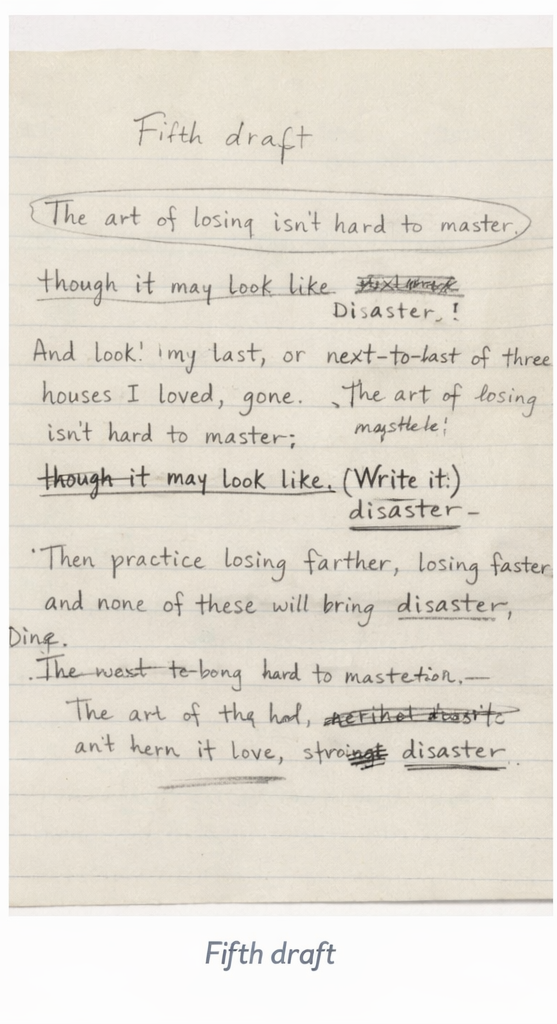
The villanelle tightens as repetition begins to take emotional weight.
Not until the eleventh does she arrive at the parenthetical “(Write it!)”—the moment the speaker’s composure breaks, the poem become itself.
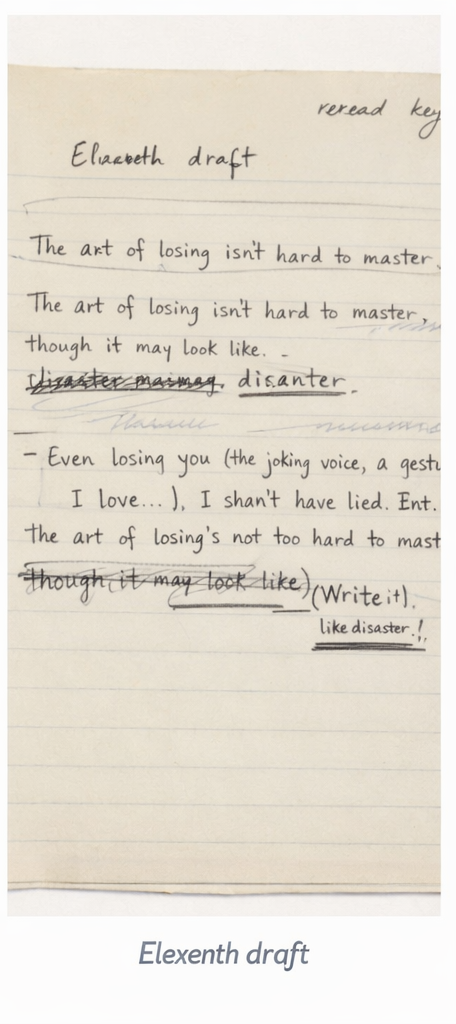
in composure that becomes the poem’s emotional hinge.
And still Bishop revised. Through seventeen drafts total. Seventeen times she returned to the poem, adjusting, pruning, testing. Seventeen times she practiced what poet Rachel Hadas calls “the art that conceals art”—the patient labor that makes the finished thing look effortless.
Robert Lowell, in his elegy for Bishop, called her the “unerring muse who makes the casual perfect.” But Hadas pushes back: this description, however loving, “does not take account of the dogged determination and persistence Bishop’s revisions present.” The drafts prove it. Perfection was not unerring. It was earned.
revision is an act of obsessive perseverance,
not a waiting game for divine inspiration
The Draft as Parallel Track: May Swanson’s “Questions”
But not every draft collection tells a story of linear improvement. May Swenson’s papers offer a different lesson.
Her poem “Question” appears in its finished form as twenty-one spare, unpunctuated lines. It opens:
Body my house
My horse my hound
What will I do?
When you are fallen
The rhythm is urgent, galloping. The metaphor—body as animal—unfolds with fierce economy.
Then you encounter the early draft.
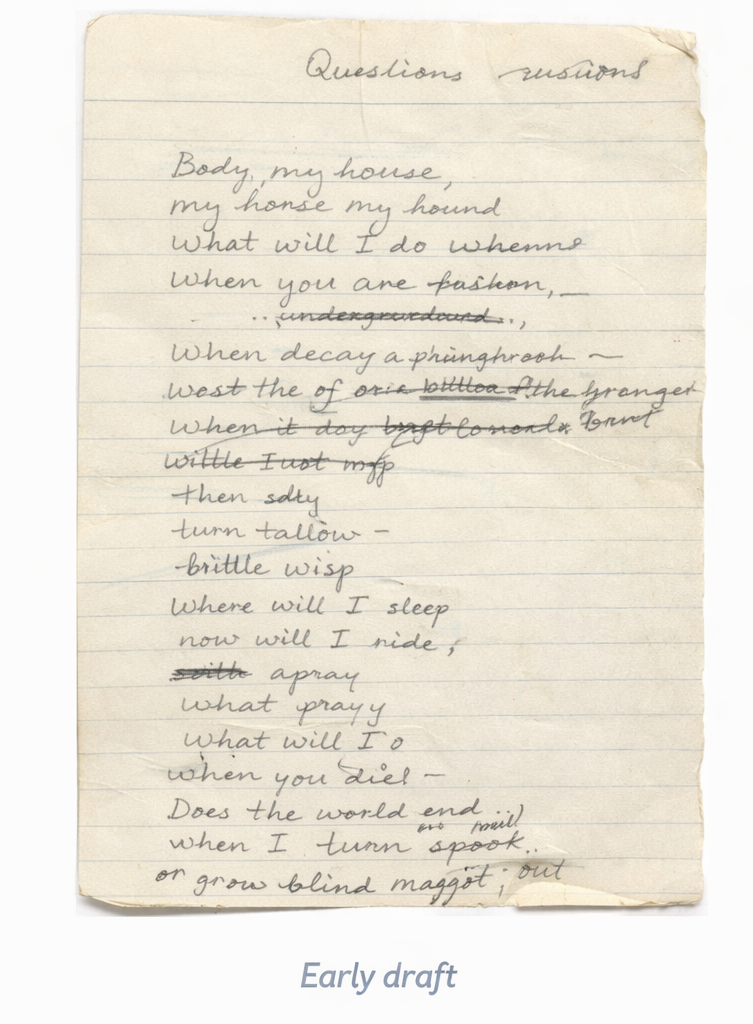
where metaphor unspools in excess before being pared down.
Fifty lines long. Each line roughly ten beats. The same opening image appears, but expanded: “Oh body my house my horse my prick-eared hound/ when you are lame then blurred then fallen” The draft continues, unspooling the metaphor in vivid excess: the animal’s “smiling sleep, flung before the fire,” its “frosty forelock and drooping back,” the “love kill home wet-jawed.”
These lines are not inferior to the final version. They are simply different— more expansive, more narrative, more openly sensual. Swenson did not revise because the early draft was bad. She revised because she chose minimalism over abundance, suggestion over explication. The decision was aesthetic, not remedial.
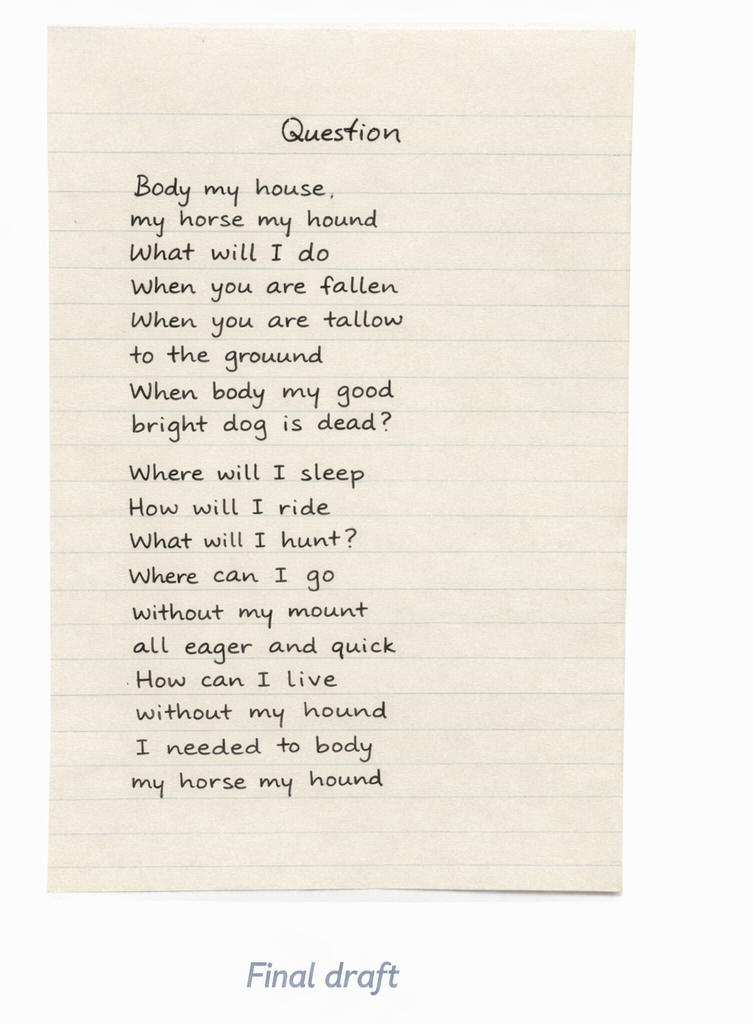
What once expanded now moves with fierce economy.
The drafts of “Question” remind us that revision is not always the uphill climb toward an ideal form. Sometimes it is a fork in the road. Sometimes the poet leaves behind beautiful writing—genuinely beautiful—because it does not serve the poem she has decided to write. Scholar Kyle Booten, reflecting on Bishop’s drafts, argues that we should we should read them as more than “imperfect precursors.” They enact their own poetic logic, their own “vertiginous dilation of thought, expression and memory.” The same is true of Swenson’s abandoned lines. They are not failures. They are evidence of possibility—the roads not taken, still visible on map.
The Digital Urgency: Mary Jo Bang and the Archive of the present
If poets’ papers have always mattered, they matter now in a new and urgent way. The material record is shifting.
Mary Jo Bang, whose papers reside in Washington University’s Modern Literature Collection, recently reflected on what it means to archive life in the twenty-first century. Her collection includes over ninety boxes of analog materials and—crucially—more than 125,500 digital files. Drafts exist across formats: typed pages, handwritten notes, email correspondence, restaurant receipts with single lines scrawled on the back.
The very ease of digital composition—
the ability to revise without leaving a visible trace—
threatens to erase the evidence of process.
Bang’s decision to commit her papers to an archive was shaped by her own encounter with Bishop’s drafts. As an MFA student in the early 1990’s, she and a friend took the train to Vassar to see the “One Art” manuscripts. “It was inspiring,” she said. “To see drafts of ‘One Art’ evolve from a rather artless expression of unrequited love into the poem we know today. It caught me that revision is an act of obsessive perseverance, not a waiting game for divine inspiration.”
Now Bang faces the challenge of preserving that same record for future readers. But digital files are fragile in ways paper is not. Formats become obsolete. Hard drives fail. The very ease of digital composition—the ability to revise without leaving a visible trace—threatens to erase the evidence of process. “For years, I’ve mainly composed on the computer and I realize I should be printing individual poems,” Bang admits. “Now, I realize I should be printing individual drafts as I go and keeping them in chronological order, it’s easy to assume that everything written on a computer is forever retrievable, but I’ve learned that’s not the case.”
Her advice to poets is simple and radical: keep both paper and digital records. “The writing we leave behind can be precious, not only to our families and loved ones but also to future generations who might want to understand what it was like to live in this moment.”
Bang’s project, the Born-Digital Poetry initiative, is an attempt to build bridges between analog and digital archiving, to ensure that the creative processes of our time remain legible to the future it is, in essence, an effort to keep the mess visible.
Why the Mess Matters
What do we lose when we lose the drafts?
We lose the evidence that poems are made. This may sound obvious, but its implications are not trivial. The myth of effortless genius does real harm. It discourages young writers who measure their messy drafts against finished poems and conclude they lack talent. It obscures the centrality of revision to any serious artistic practice. It turns craft into a mystery rather than discipline.
poems contain their own vanished histories.
The archives undo this myth. They show us Bishop, the century’s most unerring muse, struggling through seventeen drafts. They show us Swenson, ruthlessly carving away her own beautiful lines. They show us Ted Hughes, collaborating with artist Leonard Baskin, the drafts of Cave Birds interleaved with prints and letters, the boundaries between poetry and visual art dissolving. They show us contemporary poets like Bang, working across formats and mediums, trying to leave a record that future readers might find useful.
And they show us something else: that poems contain their own vanished histories. Every finished poem is a kind of archive, preserving traces of what was cut, what was almost written but set aside. The drafts make those traces visible.
An Art That Conceals Art
Rachel Hadas, reflecting on her own revision process, describes the satisfaction of a poem finally “snapping shut.” Her poem “The Red Hat” was initially titled “Walking to school II”—accurate but uninspired. An editor at The New Yorker asked for something else. Hadas cannot remember who first suggested the phrase from the poem’s final line, but she remembers the click when the title fit. “It fitted; click. The poem was complete.”
She hopes, she writes, that Elizabeth Bishop heard “a much louder click—really a bang—when she finally got ‘One Art’ just right, so that it is hard to imagine it could ever have been any other way.”
This is the paradox at the heart of poetic craft. The finished poem makes its own necessity feel inevitable. It becomes impossible to imagine otherwise. But the drafts—those patient, persistent, messy drafts—testify that inevitability is earned. The poem could have been otherwise. It almost was.
The scholar Linda Anderson and her co-editors, introducing a recent collection on poetry archives, argue that the growth of these collections has fundamentally changed how poets think about their work. We write differently, perhaps, knowing that our drafts might survive us—that future readers might trace our own abandoned lines and recovered refrains. I began to explore these drafts because I remember the first time I saw a poet’s crossed-out lines and felt something unclench in me. We write with an awareness that the mess is not something to be ashamed of. It is the medium of the art. And we hope that future reader—scholar, student, poet—will find in our struggles, our abandoned lines and recovered refrains, the same permission we once found in the archives.
The Poem in the Mess
To read a poet’s drafts is to witness thinking in progress. It is to see a writer trying on tones like garments, testing which fit. It is to watch a line slowly, painfully, discover its proper shape. It is to encounter doubt, persistence, fatigue, and sudden clarity.
The finished poem is not the opposite of this process. It is its residue. The art that conceals art is still art—perhaps the highest art. But the concealment is not erasure. The drafts remain, in archives and boxes and hard drives, waiting for the reader who wants to know how the thing was made.
That reader might be a scholar, tracing influences and revisions. That reader might be a student, encountering for the first time the evidence that poems do not spring fully formed from the brow of genius. That reader might be a poet, stuck on a draft of her own, seeking not instruction but solidarity: Bishop took seventeen drafts. Swanson cut fifty lines, Bang prints her files and keeps her receipts. I can keep going.
The poem in the mess is not yet the finished poem but it is already the writer, alone with the page, trying to get it right. It is already enough.
___________________________
Joan Muthoni is a freelance writer and poet who creates engaging work across digital and literary spaces. She writes about storytelling, the creative process, and the ways revision reveals the deeper life of a text.