

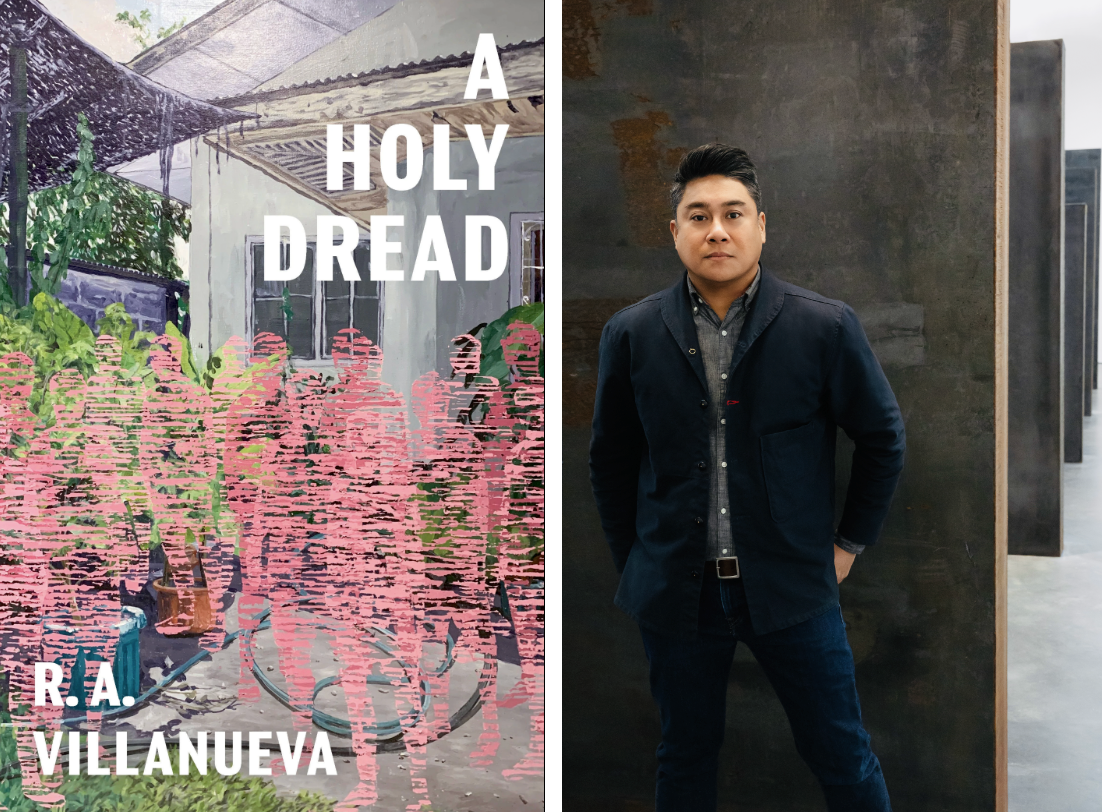
R. A. Villanueva is the author of two award-winning collections of poetry: A Holy Dread (Alice James Books, 2026), and Reliquaria (U. of Nebraska Press, 2014). New work has been featured by the Academy of American Poets and National Public Radio—and his writing appears widely in international publications such as Poetry London and The Poetry Review. His honors include commendations from the Forward Prizes, and fellowships from the Sewanee Writers’ Conference and the Constance Saltonstall Foundation for the Arts. He lives in Brooklyn.
____________________
Tiffany Troy: In your launch event with Pádraig Ó Tuama at Liz’s Book Bar in February, you said one of the defining marks of your poetry are dinosaurs and Jesus. You explain in the notes that the phrase, “holy dread” draws from Mary Ruefle’s Madness, Rack, and Honey, whereby she glosses on Julian of Norwich’s Revelations of Divine Love with: “the fourth form of dread is ‘born of reverence,’ the holy dread with which we face that which we love most, or that which loves us the most.’” How did you land upon the title?
R. A. Villanueva: When I first encountered those words, I was on the other side of the country. Madness, Rack, and Honey was the book I carried with me on the plane from New York to California, and many of the pages are folded-over and covered with notes.
I was visiting my sister and her family in Los Angeles. My parents were there, too—and in the quiet moments I found myself clumsily toggling between my everyday life and my writing commitments. In particular, I was supposed to be finishing an “About This Poem” reflection for a poem of mine named “Annus Mirabilis,” but I couldn’t find my footing. Don’t know if you’ve ever experienced this, but I both completely understood what I needed to say, but also didn’t have the language to give those feelings form.
And so it was that small, piercing moment from Revelations of Divine Love (via Ruefle) that somehow distilled for me the miracles and the enduring worries of fatherhood, the double-binds and dilemmas. In my annotated copy, in that passage you quoted, “holy dread” is underlined with pencil, then haloed with sunburst doodles and highlighter.
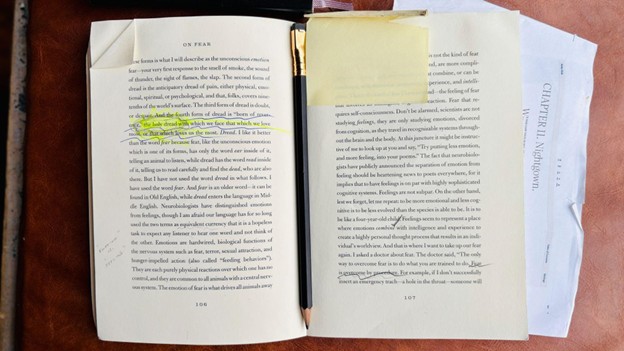
I remember sitting in my sister’s kitchen, recognizing a resonance—or a dialogue, really—between the astonishments and anxieties of loving/raising/cradling my son, and that transcendent and often visceral fear “with which we face that which we love most, or that which loves us the most.”
Fast forward a few years and I can’t escape the magnetic forces that “holy” and “dread” exert upon each other, and on my imagination. After my daughter was born, the phrase shifted a bit to “our holy dread” in a poem titled, “Book of Hours,” which tries its damnedest to celebrate and meditate on the surreal joys of living with both children. Warp ahead a couple of summers and the phrase expands, becoming A Holy Dread. We’ve moved from Julian of Norwich’s limiting, specifying article to my possessive plural, to that indefinite, ever-open, ambient “A.”
TT: The idea of deepening is something you open with. “Cusp,” which opens A Holy Dread, begins: “A week home and my nephew has/ now surprised me with this tooth he/ places in my palm with the force and grace of a small god.” Why start there, at the cusp between innocence and knowledge, from the perspective of someone who has seen the skulls and their ghosts? How does the poem set the reader up for the poems that are to follow?
RAV: Whenever I’m asked about my thoughts on the ordination of a manuscript, or the sequencing of poems, my mind flashes to “to the right, hold on tight,” a “level design lesson” by Anna Anne Anthropy, which she originally posted back in 2009. For me, it’s a defining essay that has profoundly shaped the way I approach my teaching, my editing, and my writing.
In it, she asks this catalytic question: “what if the first level of the game were laid out in such a way that the player could learn the rules simply by playing through it, without needing to be told them outright?” And then she explores the imaginative infrastructure of World 1-1 of Shigeru Miyamoto’s and Takashi Tezuka’s Super Mario Bros., revealing how all the information we (players) need are presented right there, intuitively, at the very start. We’re shown dangers and counters, taught how to brace for pitfalls and jump toward goals.
I hold true to a faith in the ways poems and books—like video games—are interactive texts. For A Holy Dread, “Cusp” is World 1-1 (just as “Sacrum” is World 1-1 for Reliquaria). It’s meant to serve as a guide star for everything that follows. An orienting prelude that invites readers to ready themselves for the structures, cadences and thematic possibilities of the whole collection: the sonnet tradition, the body and family; inheritances, memory and mortality; songs, history and home. “Cusp” places us at the edge with all we need for what will soon be.
poems and books—like video games—are interactive texts.
For A Holy Dread, “Cusp” is World 1-1... It’s meant to serve
as a guide star for everything that follows.
TT: Your poems draw from current events as well as your background as a middle school teacher in the Bronx. In “We open class with still images where,” you write: “I spell / murmuration and listen as they write/ murder in their notes instead.” How do you allow your poetic voice to take shape in the decade in which this manuscript came to be?
RAV: I don’t know that I “allowed” myself or “my poetic voice...to take shape.” I don’t think I had much choice. How do you account for the infinite ways my experiences and epiphanies have impacted me over the course of 12+ years of living? As Gloria Anzaldua affirms: “there is no separation between life and writing…What validates us as human beings validates us as writers.”
I’ve gotten older and the poems embody that. In “Mirabiliary,” lines leap from “I do not know how much longer I’ll be // alive in this world to “On my deathbed I will remember this // afternoon.” There’s talk of generations and ghosts everywhere. Hour to hour, minute to minute, I’m reckoning with “every grim atom of the inferno / [I] could not hope to endure without” the people I love. The poems reflect that.
A Holy Dread is evidence of me fearing new fears, embracing new devotions. It’s a confrontation and celebration on my own terms.
TT: I love the collapse in the demarcation between “life and writing” as the inferno that you encountered shaped you. Turning to the overarching structure of the collection, how did you land upon the four sections? The section dividers—which appear to be redacted texts—are visually striking. How does it add to the arc of the collection?
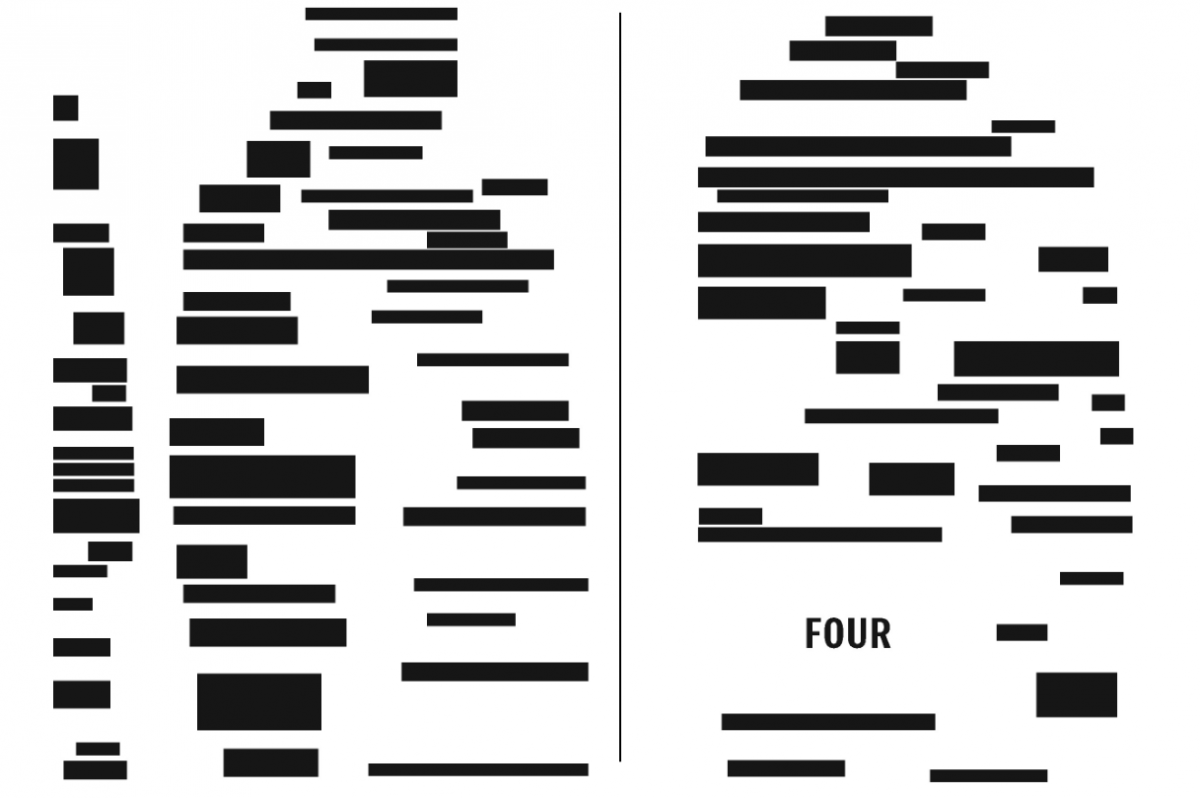
RAV: There are 4 sections in the book, with that first sonnet acting as a kind of ambassador, or guiding Virgil, for the rest of the book as it develops. I’m so grateful to my dear friend, the brilliant poet Tarfia Faizullah, for helping me realize the power of re-arranging the manuscript.
She’s the one who showed me how each particular group—or family—of poems, wrestles with its own concerns across varying scales. We move from the societal, or cultural, down to the community or the classroom or the home, zooming-in from the mythic to the individual. And it’s that third, sustained sequence, “Mirabilary,” that recontextualizes the stakes and intensifies the intimacy even more. It’s the only part sparked by its own epigraph. The only part given its own title.
You saw those interstitial pages as “redacted texts,” but I’ve always seen them as visual echoes of Full House (Ikot-ikot Po), the painting by Carzen Arpa Esprela that became the cover. It’s as if the designer transfigured Esprela’s staggeringly pink brushstrokes into thrumming, frenetic, haunting static.
A Holy Dread is evidence of me fearing new fears, embracing new
evotions. It’s a confrontation and celebration on my own terms.
TT: I admire how your framing of the visual elements as interstitial pages look at the reverberations of what is definitionally static. Could you speak next of different poetic forms in A Holy Dread?
RAV: I could probably ramble on forever about my relationship to “form,” which is a concept that has grown to feel super-flexible to me. I’m probably generalizing here, I know, but aren’t many of us taught that form is mostly synonymous with static rulesets and immoveable boundaries? What dictates the parameters of a ghazal? What makes a sonnet…a sonnet?
Throughout A Holy Dread, there are moments where I fly close to formal conventions, so that the poem is immediately recognizable, or easily categorized, as “narrative” or “ode” or “epithalamion.” And there are moments, such as with “Paternoster” and “Mirabilary,” where my rebellions and shortfalls are woven into the DNA of the poem, and essential to what I’m hoping to express.
I think it’s fascinating to face these received presumptions about what form compels us to do, and what it might provoke us to try. CAConrad says: “The definition of art is always annoying to me. It needs L E S S definition, borders that are not brick, but something more porous, like pudding, yes, I prefer art with pudding borders, and you have a delicious snack as you eat your way out of it.”
It’s exhilarating to conceive of limits as freeing precisely because they offer us (whether that is practitioner, player, or poet) something to engage with, embrace, and defy.
the brilliant poet Tarfia Faizullah... showed me how each
particular group—or family—of poems, wrestles with
its own concerns across varying scales.
TT: In “Tenebrae,” you write, “Praise instead the night,/ its starless, basilica void.” In “This dark is the same dark as when you close” // your eyes,” the speaker holds his son “close like a saint shadowed by the axe,/ cradling her own haloed head in her hands.” What is “the night” to you within the context of this collection and what is it that you would like the readers to pause and contemplate?
RAV: I should take a step back and say a bit about where “Tenebrae” came from. Here’s the origin story: that poem was my answer to a prompt from National Poetry Day in the UK. I was living in London in 2015, and the theme of that year’s celebration was “light.” I was certain that we’d be hearing poem after poem glorifying brightness, the shining white of the day, the glare of the sun.
To counter that, I praised shadows. I wrote a praise song about the darknesses that are proof of life. (Which is quite literally what a doctor once said to me about reading ultrasound imaging trimester to trimester; she was searching for the darknesses that are evidence of blood and breath.)
Ultimately, back then, I didn’t want to leave “the night” as unregarded, hidden or avoided, or feared. Now, I feel the same way about things that remind me of our mortality, or that promise to leave us. I want to (re-)discover and testify to the beauty and solidarity of surviving all this together.
If indeed “the world has always been ending,” then it’s vital that we fight for each other, offer care while we can, and look more tenderly, generously upon what William Blake called the “minute particulars” of being alive.
TT: Do you have any closing thoughts for your readers of the world?
RAV: Let’s end with a couplet. Two passages. The first from Walt Whitman: “Perhaps indeed the efforts of the true poets, founders, religions, literatures, all ages, have been, and ever will be, our time and times to come, essentially the same—to bring people back from their persistent strayings and sickly abstractions, to the costless average, divine, original concrete.”
And the last, again from Audre Lorde: “Your power is relative, but it is real. And if you do not learn to use it, it will be used, against you and me, and our children...Together, in the conscious recognition of our differences, we can win, and we will.”
_____________
Tiffany Troy is the author of Dominus (BlazeVOX [books]) and the chapbook When Ilium Burns (Bottlecap Press). She translated Catalina Vergara’s diamonds & rust (Toad Press International Chapbook Series). She is Managing Editor at Tupelo Quarterly, Associate Editor of Tupelo Press, Book Review Co-Editor at The Los Angeles Review, and Co-Editor of Matter.