

in every traumatic event or loss, having a witness matters,
even after the fact. Having a witness makes our recovery possible.
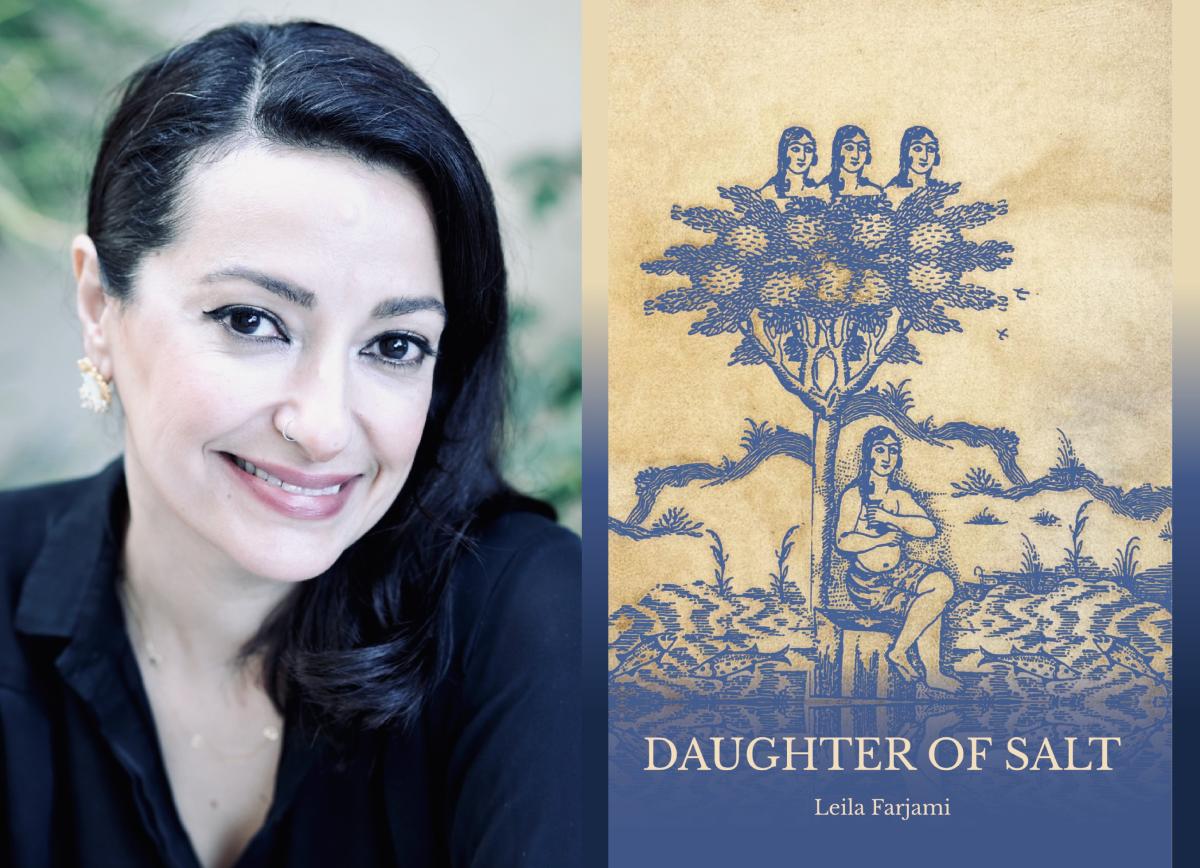
Leila Farjami is an Iranian-American poet, translator, and psychotherapist, and the author of Daughter of Salt (Trio House Press, 2026), an Editor’s Selection. Her honors include a Pushcart Prize, The Iowa Review Award in Poetry, The Cincinnati Review’s Schiff Award, and a PEN America Emerging Voices Fellowship. Her poems appear or are forthcoming in Ploughshares, The Iowa Review, AGNI, The Missouri Review, Ninth Letter, Beloit Poetry Journal, and Copper Nickel, among others. Her poems have been anthologized by Guernica Editions (Woman, Life, Freedom) and Sundress Publications. She lives in Los Angeles. Find her at leilafarjami.com and @leila_poetry.
____________________
In your opening poem “Creation” you open with “Become. Become. Blue mouths spoke me into existence– I became a sun-pit, a moon-fruit, a daughter of salt.” As readers, we are immediately introduced to the title of your book. Why did you decide to have this be your opening poem and have it introduce readers to this collection?
I had written the opening poem as part of a series of poems titled eponymously with the book, “Daughter of Salt.” After reflecting on the arrangement of my collection as a manuscript, I was drawn to this particular poem, “Creation,” as the opener for a few reasons. I then decided that I didn’t want it to belong to the Daughter of Salt series, as it desired a place of its own and needed to stand alone. Chiefly, I thought of it as a creation myth, and also as the origin of a metamorphosis into a daughter who carries wounds, grief, generational burdens, etc. I thought this particular poem had enough mythical weight and also the mystical bearing of human transformation. It seems that this particular daughter has become an archetype of her own for me.
Throughout the book there is a sequence of poems with the title “Daughter of Salt” that are rooted in magical realism/mythology and in their existence are tied to lineage and ancestry. I found these poems to continue a specific narrative around the idea of becoming through the speaker. What made you decide to place these poems in the collection where they are within the book, and how did that process impact the book as a whole?
I love your take on the “Daughter of Salt” poems as being about becoming. The Daughter of Salt poems include “Wound,” “The Shipwrecked,” “Dakhil (prayerwish),” “Sea,” “Half-Parted,” and “The Escape.” I think there’s a progression from the original wounding to flight. In psychological terms, one first becomes aware, then takes action. There’s certainly an arc of healing and a trajectory toward self-emancipation here. “The Shipwrecked” and “Dakhil” offer a lens into matrilineal suffering. “Sea” is devoted to patriarchal violence and its aftermath. “Half-Parted” is the daughter’s realization that she cannot “give salt in sugar.” She cannot offer anyone what she has not been given or learned. “The Escape” is about how she gathers herself and flees for survival. This is an act of ultimate self-compassion. How we run from the source of dysfunction and plight, preserving hope and our own dignity, toward the unknown, and trusting that this cosmic mystery will support us, is really the way we grow, heal, and become whole.
My clinical experiences have taught me that
when there’s even a speck of light visible to a despairing client,
their motivation can be sparked...more directed and solidified.
You have another series of poems with the title “Blue Mouths” which was also introduced in the first lines of your opening poem, and it is the title of the closing poem of the collection. How do these poems speak to the other poems?
The Blue Mouths poems serve as the voice of witness. Of course, I only realized this upon reflection. The Blue Mouths poems foreground matrilineal grief and the daughter’s inheritance. I feel that these poems amplify and affirm the narrator’s voice in the collection by supporting pieces of her personal history. When I wrote the first Blue Mouths poem, my intention was not necessarily to create an alter ego or a secondary voice that would back up mine. Looking back, I can see why this was a natural progression, since in every traumatic event or loss, having a witness matters, even after the fact. Having a witness makes our recovery possible.
Even though you explore themes of immigration and complex trauma in Daughter of Salt there is an undercurrent of hope and healing. While reading I noticed a juxtaposition of hurting and carrying on. What about your experience as a psychotherapist influenced your crafting of these poems?
Both as a psychotherapist and as someone who has had to deal with her own trauma history, I have always been inspired by the realistic possibility of healing, integration, and moving out of and forward from the ruins. Hopefulness is essential to our evolution. My clinical experiences have taught me that when there’s even a speck of light visible to a despairing client, their motivation can be sparked, and their commitment can become more directed and solidified. So, although I am rarely an optimist, it’s been natural for me to move through all the difficult material that you may read in this collection with a hopeful and defiant heart. I do believe in the transformative energy of one’s dedication. I love the old Buddhist adage: “Before enlightenment, chop wood, carry water. After enlightenment, chop wood, carry water.”
Hopefulness is essential to our evolution.
Do you have any closing thoughts for your readers of the world?
I hope that every reader can find something resonant or even useful in Daughter of Salt. I hope they can find moments of self-affirmation, beauty, and inspiration. I would also like my readers to reflect on the havoc wreaked by patriarchy and the brutalities committed against those who are most vulnerable and marginalized. There is an undercurrent of people dedicated to toppling old paradigms and establishing a renewed and inclusive arena for all who have been wounded by them. I’d like for my readers to feel less alone and more supported after finishing Daughter of Salt.
_________
Kayla Torres is a freelance publicist specializing in comprehensive media campaigns for poets and nonfiction writers. She is a poet, and her work has been published on The Little Infinite Instagram page. Kayla is also the social media manager for an indie press. She always has a book at hand, and you can see what she is reading on Instagram @the.bookish.mama.