

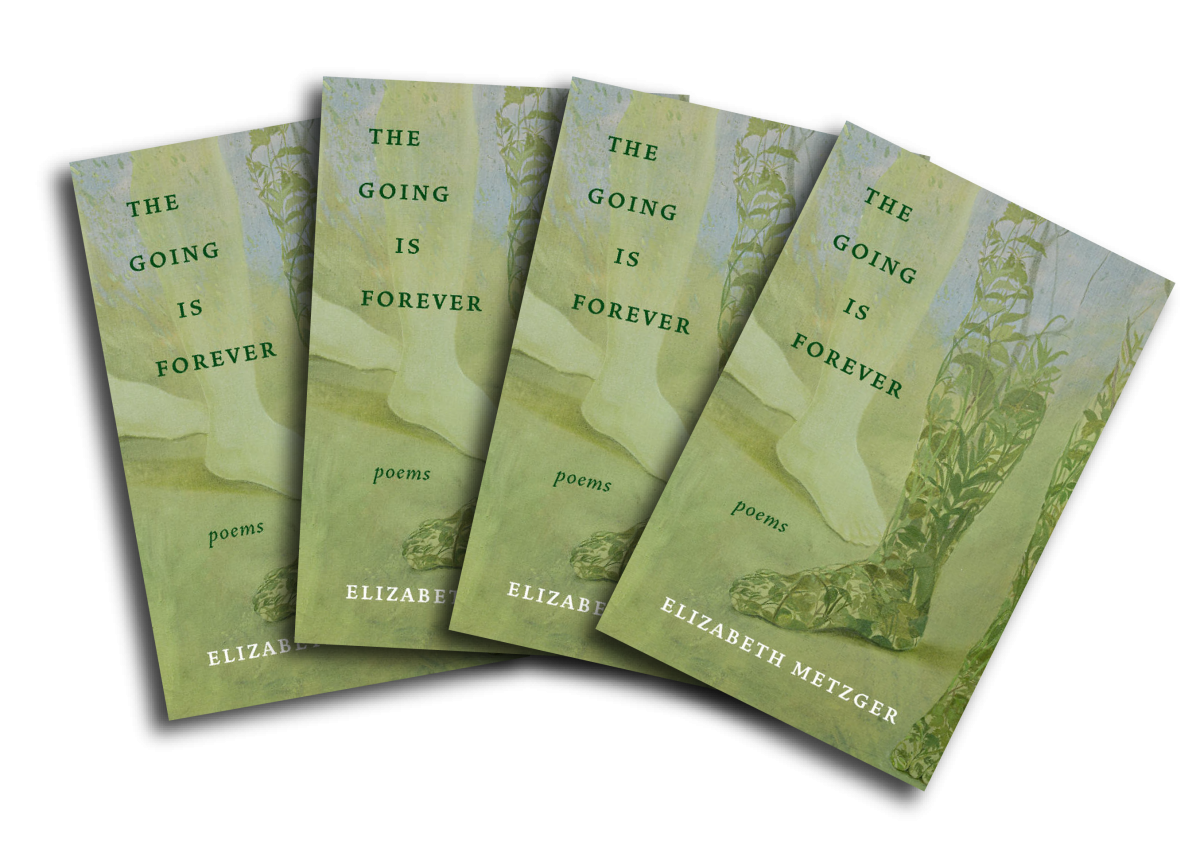
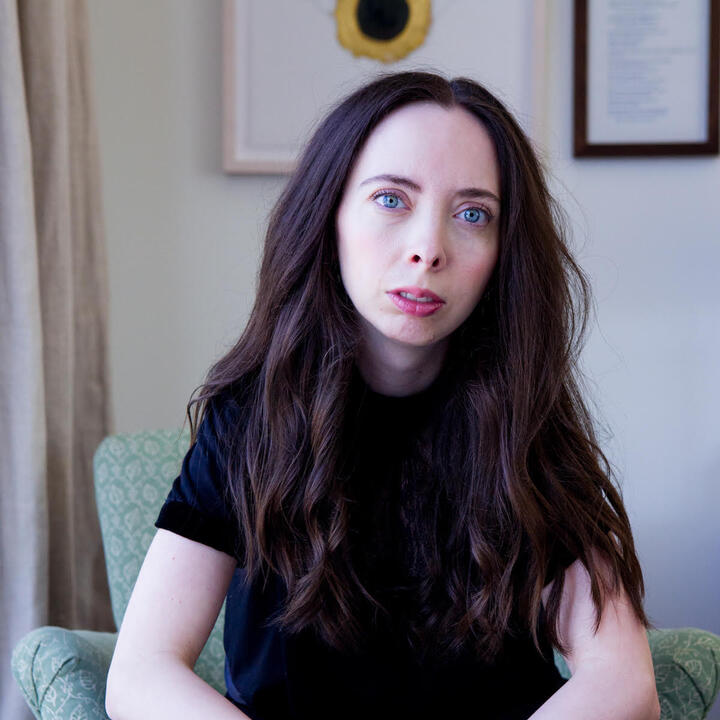
Elizabeth Metzger is the author of The Going Is Forever, which will be published 9/15/2026 with Milkweed Editions and can be preordered here. Her previous collections include Lying In and The Spirit Papers, winner of the Juniper Prize for Poetry. She has published two chapbooks, Bed, winner of the Sunken Garden Prize, and The Nutshell Studies of Unexplained Death. Her poems have recently appeared in The New Yorker, The Paris Review, The New York Review, TLS, and Poetry. She has received support for her work from The Corporation of Yaddo and teaches at Columbia University and the 92nd Street Y. She is a poetry editor at The Los Angeles Review of Books.
________________________
In “Don’t Make Me,” the speaker tells her son “the crab on the beach was dead” and “a yearlong misunderstanding” ensues of “what’s dead,” and of what goes and what stays. Then, “suddenly [the son] shot up from the covers/ done crying." The speaker's son asks, in an epiphany made possible by the freedom of childhood: "So/ the going is forever?"
How do you feel the title, The Going is Forever, serves to frame your collection? To me, the speaker carries an awe for the eternity of what goes forever.
Thanks, Tiffany. I think the idea of holding awe in the face of grief is important to the poems in the collection. Loss changes the ways we love, but it doesn’t take love away. When my son said a version of that question, soothing himself, from his first “existential” crisis, I remember I answered yes immediately. The poem doesn’t end on a yes; it ends on his question. In the title, however, it is not a question. I think of the title as the invisible answer, the yes the book was born from: leaving one version of life and asserting that life is ongoing, rather than a “gone forever.”
The opening poem, “With Each Bird Flying, Time is Passing,” begins in the sphere of domesticity: “Candled horses run across the dining table” and but for the broken monostich (a one-line stanza) ending the poem, is in the couplet form. How does this poem introduce the readers to what is to follow?
Each poem felt like the beginning of the end, the way an ending never ends, so this poem sort of flies into that openness. The title comes from Etel Adnan’s Night, and I think the poem foreshadows the last “night” or phase of a love story, the fracture of a relationship, which changes but cannot end, partly because of the children. That loss requires falling in love with one’s own life again. Sometimes when we feel broken, we have to fly in order to move on at all. A line, as a unit of poetry, feels this way to me, too.
I need to feel led by words through silence, before I know where I’m going or why."
I’m curious about your sense of time in your third poetry collection, which felt more expansive (in large part because it felt even more introspective in its confrontation of the cringe and the shameful), and less delimited by a time period. What was the process of writing and putting the collection together?
Putting together a collection is so hard. How do you make an ending have momentum, possibility? I knew the book needed to be in three parts, a trinity of defining masculine forces (father, son, husband) I had to lose in various ways in order to love. The husband and son insisted on being braided together since marriage affects the whole family.
But what to do with the death of my father, the loss of a parental figure who felt like a stranger even though he remained married to my mother and lived with me my whole childhood? No matter where I sprinkled the “father” poems, they disrupted the rhythm of the book. Finally I kept them all together in the middle of the book, an interlude or respite from the nuclear family, a present absence around which my idea of family could dissolve and reform. I didn’t see it at the time, but my father’s death took me back to my original family and became a catalyst to the final moments of my marriage and the final section of poems. I had to face what was missing in me rather than what others had taken away.
somewhere in a poem, where as soon as I think I understand
the meaning or music, I turn back like Eurydice, reopen the wound.
The speaker’s turn towards her interiority is accentuated by the line breaks, caesurae, and poetic form. In “Echo of the Air Around Me,” for instance, it was very much about that turn: “In June I held it to my head / screaming I could return you to any beach // but it was myself I heard crying / myself I heard leaving.” In what ways are your words (and the forms it finds) wiser than yourself?
Well, maybe poems (my own and others’) are wiser than the words I try to use to describe my feelings in conversation. All art tends to be smarter than we are, I guess. In terms of form, I think of white space as an emotional pressure. I need to feel led by words through silence, before I know where I’m going or why.
I agree that the turn you quoted is a swerve, and this often happens for me somewhere in a poem, where as soon as I think I understand the meaning or music, I turn back like Eurydice, reopen the wound. The lines you quoted expose a break between my rage against the shell and my recognition of the sadness I hid behind that rage. All white space is vulnerable, a failure, a bid for trust. Maybe a caesura is the most risky, disrupting mid-line (a line, often already a fragment of a sentence). A Caesura says no punctuation mark can make you breathe, but here you must hold your breath.
In “Second Thoughts,” you ask: “Who wouldn’t be embarrassed to believe in nothing / and be aroused by everything?” In “Never Finished,” you write: “My wetness under water / silent as a star pointing all directions.” What was your approach in writing about the autobiographical from the lens of a mystical self? How does poetry transcend the silence of motherhood (from societal expectations and the expectations of the self)?
I like that word mystical–there is an eros to trying to say what is unsayable, or not looking away from the unknown. Uncertainty and not being understood are frustrating, if not devastating. But in poems, those extreme feelings in realms of uncertainty only enhance our attention and life force. I think that kind of mysticism became more corporeal for me after becoming a mother. It was as if, after having children, a part of myself that had been overshadowed by the desire to be a mother, could rise to the surface.
Of course, I mostly experienced touch (and the gaze) from my children. The less erotic the uses of my body, the more I could recognize a physical exhaustion as a physical longing, something that felt more potent than anything I could articulate or enact. In the same way that spiritual language is sure to fail (there’s that word apophasis, which Michael Sells refers to as “the mystical language of unsaying”), The Going Is Forever speaks to our inability to ever consummate desire, to be consumed instead by unfulfillment. In another poem I plead for the “Lord” but the poem ends “I would give you up still for a person.”
In poetry what is absent or unspoken drives the utterance and magnetizes one’s presence. One must fill in what’s left out, even if we are aware that it’s not quite right. The poems I love to read say take me, then yearn for more. That is one gesture of poetry, to turn pain into pleasure. Pleasure hurts, too.
Do you have any closing thoughts to your readers of the world?
Thank you for your beautiful attention to these poems, Tiffany and anyone who ends up reading this. The idea of this book being read by people I’ve never met is similar to the beautiful terror of being ready to love again. Let’s try not to think of life as good and bad experiences, but as a series of surprises that change our stories, stories we will forever rewrite. I guess for me, writing, like love, begins with a desire to see and be seen. I hope readers feel seen in my poems–and fall in love with their own many lives.
_________________________________
Tiffany Troy is the author of Dominus (BlazeVOX [books]) and the chapbook When Ilium Burns (Bottlecap Press). She translated Catalina Vergara’s diamonds & rust (Toad Press International Chapbook Series). She is Managing Editor at Tupelo Quarterly, Associate Editor of Tupelo Press, Book Review Co-Editor at The Los Angeles Review, and Co-Editor of Matter.