

At the heart of this book is a desire to smudge
the dark line we often draw between “human” and “animal.”
Catherine Pierce is the author of the poetry collections Danger Days, The Tornado Is the World, The Girls of Peculiar, and Famous Last Words, as well as the memoir Foxes for Everybody. Her work has appeared in The Best American Poetry, The New York Times, The Nation, American Poetry Review, and elsewhere, and has won two Pushcart Prizes. A recipient of fellowships from the National Endowment for the Arts and the Academy of American Poets, she served as Poet Laureate of Mississippi from 2021 to 2025. Visit her online at: https://www.studioandcraft.com/.
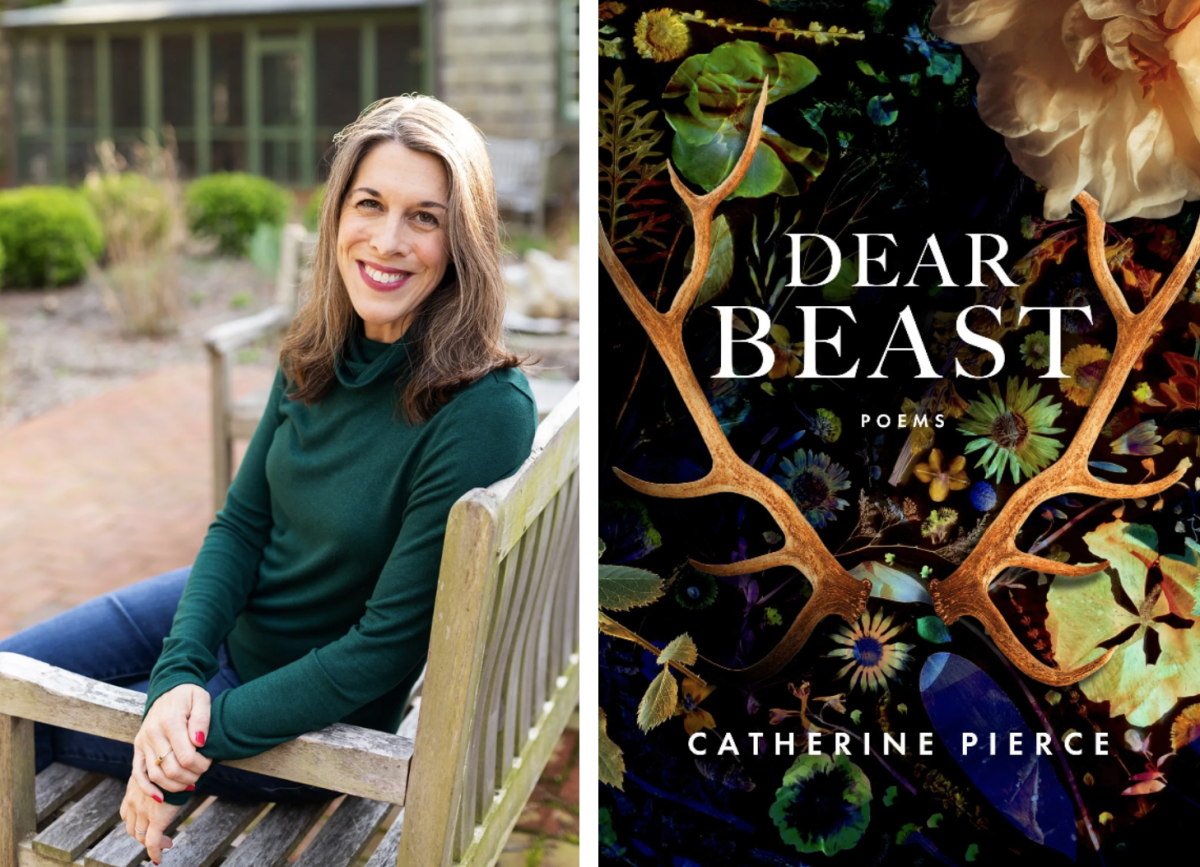
To celebrate National Poetry Month, I chatted with Catherine Pierce, author of Dear Beast (Saturnalia Books, 2026). Vivid and tender, Dear Beast is a love letter to our world, embracing the darkness, the light, and all the liminal spaces between.
Stacey Balkun: Wolves take center stage in this book, and contemporary forms of violence and fear spiral around them. Wolves are not just “where” but “when” and “why” and more--beasts are never far. In the opening poem, “I’ve Known You All My Life,” the beast is so close, but untouchable--yet also “animal inside” the speaker. What makes a beast a beast?
Catherine Pierce: That question of beastliness—what makes a beast a beast?—was never far from my mind as I was writing these poems. There’s a short series of poems in the book that uses the language and imagery of “beast” to explore topics associated with mundanity and quiet (“Domestic Beast,” “Midlife Beast,” “Suburban Beast”). There’s so much wildness in the landscape of a life, a family, a body, a home, and we are, at our core, animals—human animals, yes, but “human” is really just a parsing of a taxonomic rank. I wanted to bring the terminology of wildness into domesticity, aging, motherhood, the supposed placidity of a suburban existence. We’re animals navigating our lives with all of our teeth and longing.
The wolves in this book—the imagined ones (the Wherewolf, the Whenwolf, the Whywolf, etc.)—are all, I think, sympathetic figures, grappling ceaselessly with questions and worries, though they may present as fearsome. Their concerns are largely human, but I still see the Wolves as animals, albeit invented ones. At the heart of this book is a desire to smudge the dark line we often draw between “human” and “animal.”

SB: Yes! These poems center that liminality and overlap. Definitions are complicated. There is no either/or. That being said…what is a wolf to you, to the speaker of these poems?
CP: A wolf is a wolf. But a wolf is also fairytale, teeth, wildness, danger, tenderness, and the stories we carry inside us. In this book, I wanted to get at that both-ness, to honor animals as who and what they are while also acknowledging the human impulse toward metaphor and association.
SB: So many of these poems take place in a specific moment of a specific era (COVID-19 shutdown), and yet they are timeless. Can you speak to your experience of writing the pandemic? Did these poems come in the moment, or after?
CP: Most of the pandemic poems were written during that time—not during the first part of it, when I was too stunned and reeling to have the perspective or language to write about what was happening, but later, as I began to process my own experience of this moment. For a while during the pandemic, I couldn’t write at all, or at least very little; when, in early 2021, I found myself writing poems again—the poems weren’t solely about the pandemic, but it certainly found its way into much of what I was writing at the time—it was a tremendous relief, to be able to think about this time rather than just keeping my head down to get through it, and to try to make something with my experience of it.
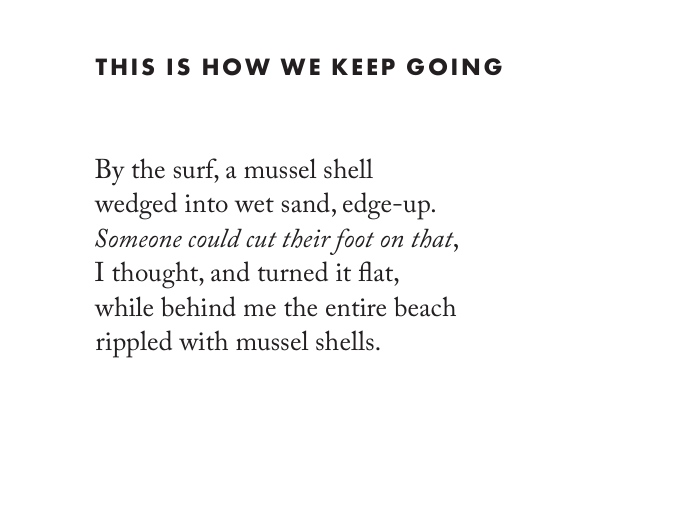
SB: That experience speaks to many of us. Finding that time to reflect and think was so hard for so long, and I craved that time. The Poem “This is How We Keep Going” reminds me of Basho. It’s short, image-driven, quiet. As a reader, this piece offered a breath in the midst of so many expansive, almost breathless poems. What inspired this to be a short poem, rather than a piece of a longer work?
CP: I struggled with this poem before landing on its final iteration—the poem was always short, but when I first wrote it, I thought it needed to be part of a longer sequence of poems. The sequence was titled “In This Another Year of Our Perpetual Disintegration,” and there were other very short poems, though this one came first. Eventually I came to realize that this poem was the strongest of the series and that I’d been working on the others as a scaffolding for this one. Once I scrapped the longer series, I liked the idea of including this one near the end of the book, as a little standalone moment of focus and space.
SB: Who are your poetic influences for small forms such as this?
CP: I’m a fan of Andrea Cohen’s very short poems; I also have a lot of individual very small poems I love by bunch of different poets (W.S. Merwin, Langston Hughes, Margaret Atwood, Jane Hirshfield, James Wright, Robert Creeley…). I’ll always stop for a small poem.
SB: Love this list! In your poetry, the title is often a form in itself. The syntactical play gives us information beyond the words alone. I’ve always been a fan of your titles--can you speak to us about your titling process?
CP: Titles are such a potent poetic tool—they can do so much work in such a small space. I love a good workhorse title, one that sets up something important and then gets out of the way so the poem can range more freely. I also like playing with titles when I’m working in series, as a way to link—for my own process as much as for a reader—the poems and their projects; in this book there are several poems that explore or directly address specific creatures, and each of those titles has a little parenthetical subtitle that echoes the others (“Burrowing Crayfish [An Ode],” “Sand Crab [An Admission],” “Paper Wasp [An Apology]”).
Occasionally the title comes first, but usually it develops organically as I’m working—I’ll realize the title might be a way to incorporate additional info the poem needs, or I’ll see a thread in the poem that I want to spotlight. Titles, for me, are one of the most fun parts of the drafting process—I love playing around with different title possibilities, seeing what might tilt a poem one way or another, letting it get weird.
SB: Let it get weird! There’s a deep fairy tale influence here, and also the natural world. The book ends in the woods, near a marsh. Where do fairy tales intersect the natural world, for you?
CP: For me, as I think for so many people, fairy tales are such a deep part of my memory, an intrinsic cultural touchstone. Certainly the wolf poems—the invented characters of the Whowolf, the Whenwolf, etc.—take a cue from fairytale and fable, and though I wasn’t necessarily setting out to echo fairytales in the poems set in the natural world, that echo absolutely makes sense. In fairytales, the natural world—forests and woods in particular—is wild in a way that, for me, is simultaneously cautionary and deeply appealing. I’m drawn to that tension, to the way that the wild world is gorgeous and healing and also dangerous, to the way that we can ascribe our human interpretations to the animal world all we want, but at the end of the day, the animals are wild.
A side note: a few months ago I took a long walk in the woods behind my house after days of rain, just looking at all of the mushrooms and lichen and moss, and the phrase that kept ringing in my head was from The Lion, the Witch, and the Wardrobe: “deep magic,” as when Aslan says to the White Witch, “Do not cite the Deep Magic to me, Witch! I was there when it was created.” Surely that wonder in the woods was part of the Deep Magic; it was the stories I’d read as a child that gave me the language for what I was feeling.
SB: Thank you so so so much, Catherine! Congratulations on Dear Beast. I can’t wait to write with you again soon.
______________
Stacey Balkun is the author of Sweetbitter & co-editor of Fiolet & Wing. Her creative and critical work has appeared in Attached to the Living World, Best New Poets, Mississippi Review, and several other volumes. Stacey holds a PhD in Literature from the University of Mississippi, Oxford, where she was awarded the Holdich Scholar Award, and an MFA in Poetry from Fresno State. She has been granted fellowships and grants from the Modern Language Association, PEN America, and the Helene Wurlitzer Foundation in support of her writing. Stacey lives in New Orleans, where she can often be found in the community garden or making puppets.