

The sonnet seems like a perfect example of a 'rigid' poetic form—but the sonnet form is as dynamic and evolving as all the rest of contemporary poetry.
Traditionally, the sonnet is a "little song" composed as a 14-line rhymed poem, following either the Shakespearean or Petrarchan style. Many students have been required to write a sonnet with strict adherence to its structure (and maybe even docked points for 'breaking' any rules!).
But one of the true joys of poetry is its fluidity! Poetry is constantly evolving, and the sonnet is no exception.
Here's how four contemporary poets exploded the sonnet, and why.
wait, Are poets allowed to just...change a poetic form?
Yes.
Language is constantly evolving. That's why six seven is having a moment. It's why 'cooked' and 'let him cook' have radically different meanings. And just as language evolves, so do poems. Poetic forms, like the sonnet, are containers, a shape in which to set a poem.
Poets not only morph how language works on the word level—they shape-shift what's possible on the page.
How? Poets might keep one element of the traditional form (for example, the fourteen-line structure) while doing away with others; they will also sometimes invent their own formal containers for sonnets without much regard for the traditional strictures of line counts, meter, or rhyme.
translating English to English In "That Time in Me Amulet: Love Sonnet to Letters"
Yes—poets are so wild they will translate English into English. What does that mean? In this poem, Laynie Browne "talks back" to Shakespeare's Sonnet 73, reflecting lines back, interpreting them faithfully (or loosely), including lines of the original sonnet as echoes in her own.

For instance, when Shakespeare writes, "This thou perceiv'st," Browne hears, "I light a candle." Shakespeare's sonnet uses the the phrase "none or few," and Browne echoes it in her own poem. Shakespeare's sonnet concludes, "To love that well which thou must leave ere long." And Browne translates it this way: "I wouldn't love you any less if there were no possible end to love."
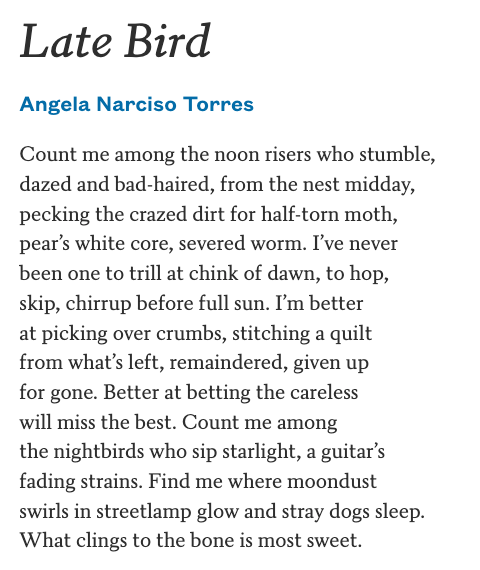
Sometimes even a single line, or even as few as two short words can inspire a response. With this very same Sonnet 73, poet Angela Narciso Torres honed in on this sonnet's 4th line and wrote a different kind of response sonnet called "Late bird." Torres explains, "this sonnet is an argument for being the late bird who lives on what’s been left behind."
Shattering the line in "Peril Sonnet"
David Baker's sonnet explodes the sonnet for a very specific purpose. He's writing about the disappearing bees, the destruction of their habitats and their dwindling populations, and every choice made in the form of the poem relates to the subject.
For instance, the opening lines of the poem would read this way, if they were structured as sentences:
Where do you suppose they’ve gone? The bees. Now that you don’t see them anymore. Four-winged among flowers. Low sparks in the clover, even at nightfall. Are they fanning? Have they gone another place?
Even structured this way, you can feel like words have disappeared. There are many sentence fragments. It may feel like a word is missing (Have they gone TO another place?). Even the first two sentences "Where do you suppose they've gone? The bees" makes it feel as though the speaker of the poem has forgotten words in their very first question.
And that's just the work the language is doing. Take a look at how Baker actually structures the sonnet:
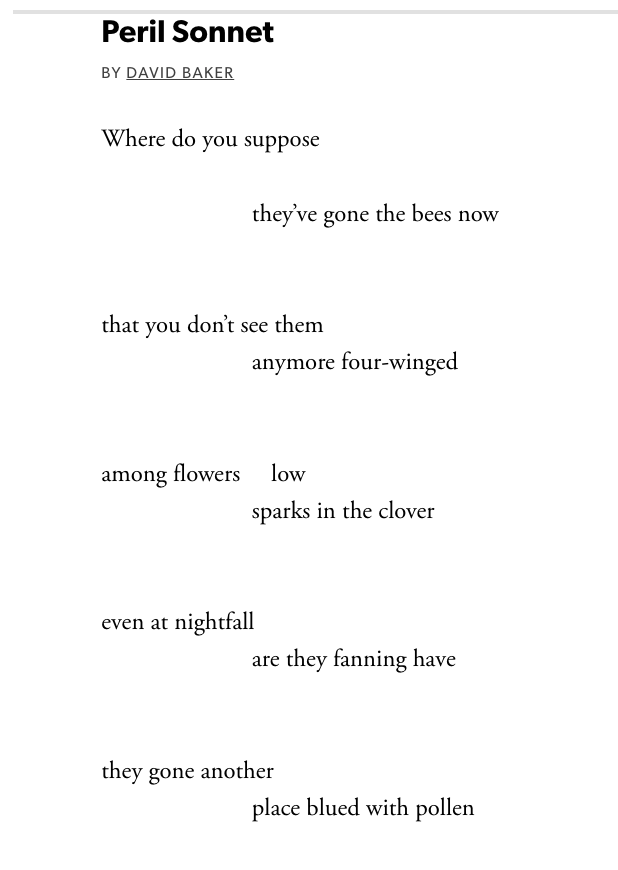
Baker completely abandons punctuation, lets the lines mush and run together in such a way that it's hard to tell where one ends and the next begins. Then, he shatters the line with a caesura (an interruption or break). Each of these choices reflect the destruction of the bee habitat that is the poem's subject.
speaking in tongues in "Sonnet for Our Lexicon"
Who said your sonnet had to stay all in one language? This sonnet by Luivette Resto retains the concision of the traditional form, but moves fluidly between Englishes and Spanishes, celebrating the richness of linguistic difference while acknowledging the reality of linguistic gaps. Language itself because "a little song."

New Twist on a Love Poem "V-Neck T-Shirt Sonnet"
Joseph O. Legaspi's sonnet is old-fashioned in its theme (this is a love poem) and new-fashioned in its form, which employs both full and slant rhymes in a playful, patterned non-pattern that conveys the speaker's bubbling-over delight in the beloved.

An excellent example of form matching content, the speaker of the poem is so flustered that it's hard to keep track of anything other than the beloved—that's how the poem can absentmindedly 'forget' to end rhyme lines like "fenced-in skin that shines./Cool drop of hem, soft & lived-in." "Shines" and "Lived-in" don't rhyme AT ALL, but the speaker doesn't care—they are too busy gasping for air, saying "let me be that endangered species...gaped mouth of a great white fish...poised to devour."
What's wonderful
There are endless ways to evolve, morph, distort, alter what has come before, and what comes after that and after and after and after. That's what language does. And poetry is an art form in praise of that evolution: reimagining, redefining, or even exploding our previous expectations of what language can or might do.