

that’s the great thing about poetry:
once you read it and present it to the world, it’s now a part of someone else’s experience, and they get to interpret the language and format in different ways.

Esteban Rodríguez is the author of ten collections of poetry, most recently At the River (Fonograf Editions 2026), and the essay collection Before the Earth Devours Us (Split/Lip Press 2021). His work has appeared in New England Review, Seneca Review, Poetry Daily, and American Life in Poetry. He is the interviews editor at the EcoTheo Review, senior book reviews editor at Tupelo Quarterly, and associate poetry editor at AGNI. With Jennifer De Leon and Ben Black, he coedited To Never Have Risked Our Lives: An AGNI Portfolio of Central American and Mexican Diaspora Writing. He and his wife own and operate Love Letter Coffee in McAllen, Texas.
__________________
Your new book, At the River, is composed of five long prose poems that are divided into sections by photographs. What made you decide to use this format for this collection rather than structured poems?
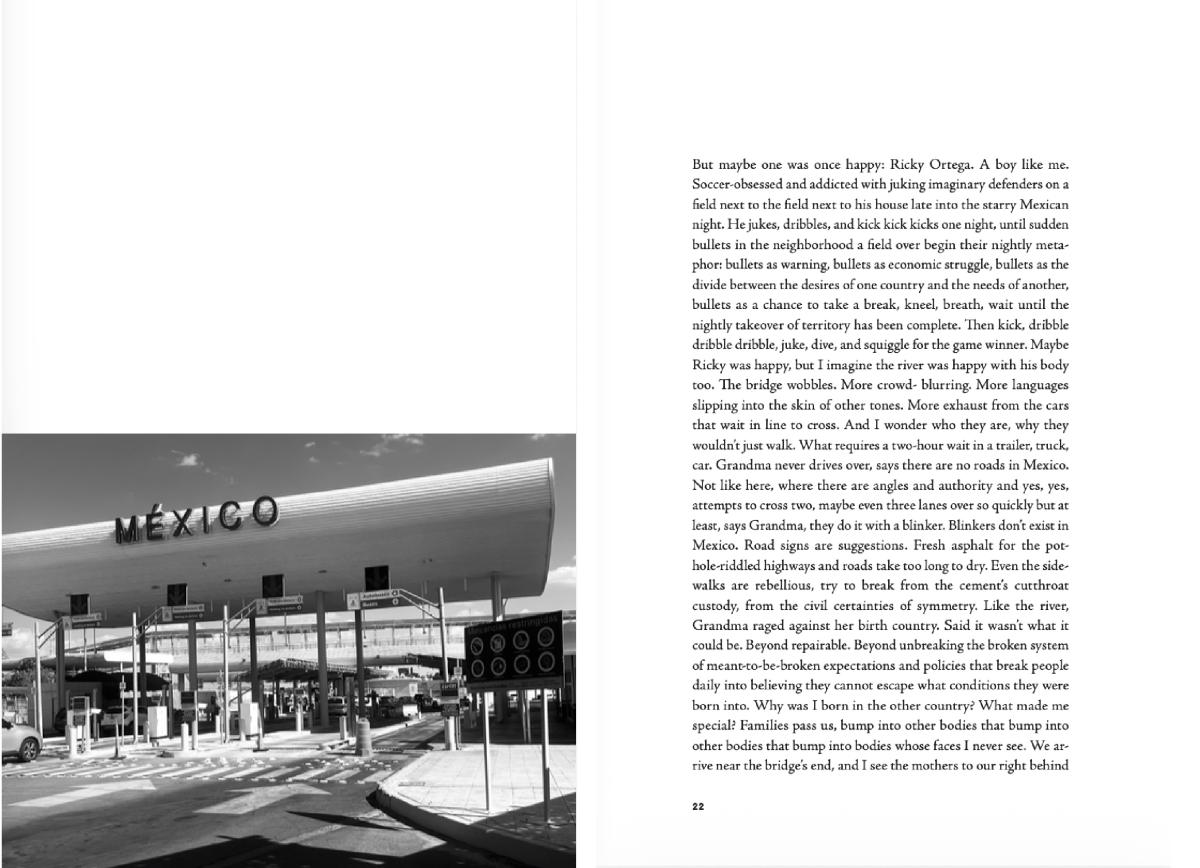
I love that you brought up the structure because I never saw it in the way that you and other people who have commented on it see it. When I started writing the book, I approached it as one continuous poem and the photographs more as interludes.
I took inspiration primarily from James Joyce’s Finnegan‘s Wake, which I have still yet to read in its entirety. I just remember reading the first five pages and being absolutely blown away by the linguistic and sonic approach of the book. I thought, “I too, can do that,” or at least try my hand at it. And then suddenly I found myself writing about crossing into Mexico with my grandmother, something we would do frequently when I was young.
Additionally, I knew that I wanted to include photographs, so even before the images were finalized, I wrote with them in mind. I am a huge fan of W.G. Sebald’s work and the way in which he incorporates photographs and drawings throughout his novels. Reading Austerlitz and The Rings of Saturn completely opened my eyes on what a text can be and what it can include. His work might read and look like it’s experimental but it’s still quite grounded in a cohesive narrative. Ultimately, that’s what I was trying to achieve.
I’ve been rereading sections of the book (mainly to prepare on how I would perform at future readings) and I can totally see the work as five related prose poems, with the photographs as section breaks. But I think that that’s the great thing about poetry: once you read it and present it to the world, it’s now a part of someone else’s experience, and they get to interpret the language and format in different ways.
These prose poems blend fact-based fiction along with your own lived experiences. Could you describe your process of blending these two narratives?
I’ve been working my way through The Asiatics by Fredric Prokosch, and even though it vividly describes an unnamed narrator’s journey through Asia, Prokosch never actually visited the continent. Prokosch used maps, travel guides, and his own imagination to paint such a detailed picture of the travels, and I couldn’t help but admire the book even more when I discovered how “inventive” Prokosch was. I love when literature doesn’t quite fit into a box, and when the authors push the boundaries and extend the truth of seemingly real life narratives. I love when readers can’t tell the difference between fact and fiction.
So, when I began writing this book, I wanted to be sure that the overall narrative was grounded in reality and that reality, as I know it now through memory, could help me explore literary avenues I didn’t think were possible.
I once heard Kim Addonizio say in an interview that her mother had to die in one of her poems because it fit with the theme and ending. I remember laughing and thinking that poets live the most lives of any writers, because they have the liberty to create alternative realities, while making their poems incredibly personal. So, yes, my grandmother and I would travel every other weekend to Mexico. She would buy fruit, medicine, alcohol even, and I would sometimes get haircuts. But we never went over to visit anyone at a clinic. We never had those surreal and horrifying experiences that the speaker does in the book. I didn’t know that the narrative would lead in that direction, but it seemed natural that that’s where it ended up (I also think I was influenced by the horror films I was watching at the time, which, if you know me, I am absolutely terrified of).
I also didn’t know that my speaker, in contemplating the people he encounters at the bridge and in coming face to face with the physical burden of the Rio Grande, would ponder the lives lost to the river. Once it became evident to me that the speaker needed to work through his understanding of the social and economic reality of the border, it felt necessary for him to start inventing names and creating stories for some of them, to fill in the gap of his knowledge about the people who live in Mexico with fiction.
I wanted the reader to feel fatigued with all these names being listed. I wanted them to know real people have lost their lives to the river because of the economic and social consequences that led them to crossing the border in the first place.
Read. Especially now.
...the world is full of technological noise that distracts us from doing what we love. But I’m hoping that books and the act of reading can save us in some way.
The photographs featured throughout the book are not used to create an ekphrastic relationship to the prose poem. During my own reading I found them to further the narrative and to enhance the imagery that the speaker is already forming for the reader. What was it like working with others to create this conversation between the prose poems and the photographs in the book?
My mother and sister took photographs for me of different places in the Rio Grande Valley for my book The Valley (Sundress Publications, 2021). I knew exactly what venues around the Valley I wanted them to take photos of, and every day in June of 2020, they took hundreds of photographs and sent them to me. They complemented the poems I had already written for this collection, and after selecting the ones that made it in the book, I was able to finalize the arrangement of the poems. In a way, part of me feels that this is very Andy Warholesque (Warhol regularly used assistants to help create his art at The Factory), but then I remember that the photographs aren’t driving the poems, but rather, enhancing them.
For At the River, it was my students who helped me quite a bit. They would send me photographs of the border and the Rio Grande and I would tell them I wanted something similar and different and we could collaborate on them. I would then alter the tone of the images and crop them to fit what I was already writing, culminating at the end of the book in a repeated image of the river that eventually goes dark. I love that I could collaborate with others, that literature can be inclusive to others who don’t participate in writing.
I love when literature doesn’t quite fit into a box
...when readers can’t tell the difference between fact and fiction.

and how one can come to terms with the symbolic weight of crossing between two worlds.
This is your tenth poetry publication. What have you learned about yourself through your writing career that helped to shape At the River?
I’ve learned that there is still so much to learn. And I mean that genuinely. I read The Summer My Mother Had Green Eyes by Tatiana Țîbuleac earlier this year, and I was absolutely stunned how emotional a book could make me feel. I wasn’t expecting that. It reminded me that literature can be powerful and that it can move people in unexpected ways.
I learned that I’m craving something beyond poetry, or more specifically, beyond writing toward a specific genre. In previous collections, I always knew that when I was writing poems, I was writing toward a collection, a book that would have between 50 and 80 pages of work. With this book, I truly took it day by day, letting the narrative unfold and allowing myself to go beyond the page with photographs, language, and format. So, I think I’m at the stage of my career where I feel much more comfortable exploring, in giving myself permission to experiment, and in taking my writing to places it's never been before.
What closing thoughts would you like to share with your readers of the world?
Read. Especially now. I think the world is full of technological noise that distracts us from doing what we love (I have definitely found myself scrolling through Instagram reels and playing online chess for hours on end). But I’m hoping that books and the act of reading can save us in some way. The world will keep on changing, and we will no doubt have to adapt to those changes. But hopefully you can find time to immerse yourself in a book, to speak in its language, navigate its narrative, and to experience a world that opens your eyes to a new, and hopefully, better way of living.
__________________________
Kayla Torres is a freelance publicist specializing in comprehensive media campaigns for poets and nonfiction writers. She is a poet,and her work has been published on The Little Infinite Instagram page, and interviews have been featured on the University of Arizona Poetry Center 1508 Blog. Kayla is also the social media manager for an indie press. She always has a book at hand, and you can see what she is reading on Instagram @the.bookish.mama.