

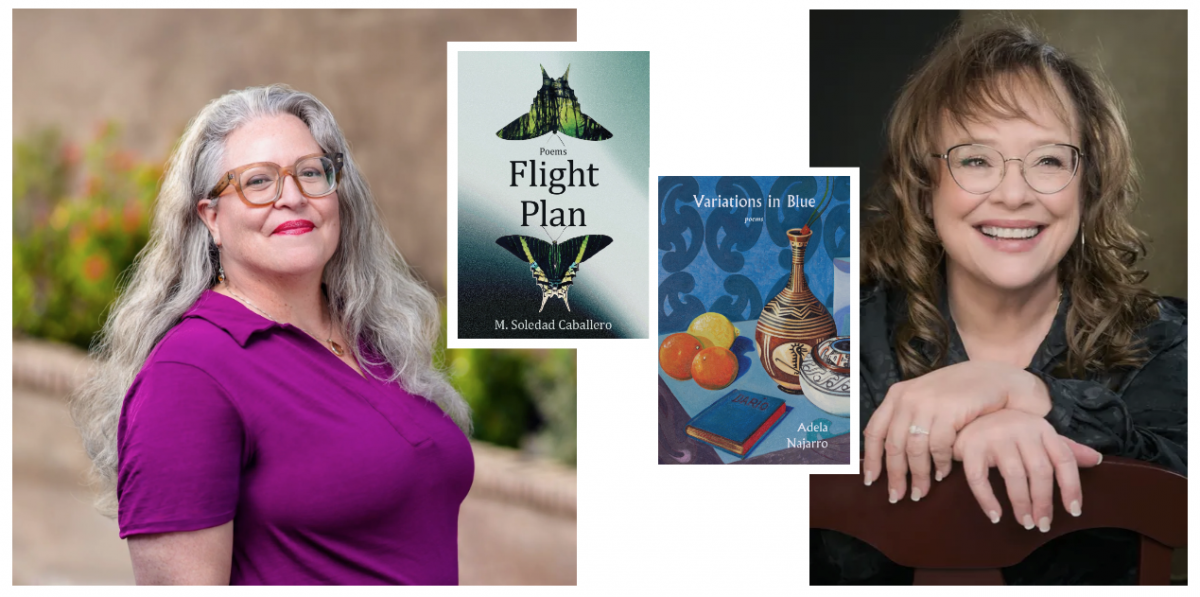
In this conversation, poets M. Soledad Caballero (pictured left) and Adela Najarro (right) discuss the intersections between their recent poetry collections, Variations in Blue and Flight Plan. Their exchange explores shared themes of poetry as a living force, the ekphrastic form, creative community, and the ways both writers engage with the complexities of identity, art, and survival. What follows is their intimate, generous dialogue about craft, influence, and vision.
Adela Najarro:
I found many commonalities and intersections between Flight Plan and Variations in Blue. M. Soledad Caballero is my literary sister. In one instance, we have both written poems where poetry is personified, and she is dangerous! In “Dear Poem” and my “What Poetry Told Me,” poetry is elusive, has a mind of her own, and as Caballero writes, she is “ready to kill,” while in my poem, “she can make a poet bleed.” Better be careful with Poetry!
Soledad, can you describe how “Dear Poem” came about and what place poetry occupies in your life?
M. Soledad Caballero:
Yes, that’s so true about our connections to poetry as an embodied entity! This poem was part of an April National Poetry Month prompt and, I think, likely also a few combined workshops. I was trying to think about the urgencies that writing poetry often brings up for me. There’s that moment when I can’t help but write. It’s a relief after that simmering time, that time just below the surface when words and sounds are whizzing all around me, it feels like.
I think that wildness of writing, or at least trying to write poetry, is what this poem brings up for me. And I was also thinking of the stuckness, the in-placedness of poetry for me too. Sometimes the urgency to write and then the passing of time waiting for it, hoping for it, wishing for it to start to buzz, is part of the feeling.
There’s a great line in Keats’s long poem Lamia, where there’s a buzzing trumpet sound in Lycius’s head after he’s been in a daze and dreaming of Lamia’s presence. The poem says something like “Lycius wake up!” That’s the back and forth of poetry for me that I was trying to capture. It’s all-consuming and also unmoving in what feels like its demands. That’s some of where this poem comes from.
In reading our collections side by side, one of the connections I was intrigued by was the use of the ekphrastic as a form. In Variations in Blue, you have poems like “On Viewing Gronk’s Illegal Landscape / Paisaje Illegal,” in which the vividness of images captures the colors of the triptych: “the fence tears blue the tongues,” and the images on the canvas “boom.” And there are other ekphrastic poems, “La Virgen de Patadas” and “La Tempestad,” both of which name a “viewing” as part of the frame of the poem, an epigraph of sorts.
Adela, can you talk about the ekphrastic poem and what it offers you as a form for poetry?
![I think of my writing life as my reading life... I often think of my poems as echoes of the writers I’ve read and [those] who have not only influenced me but who remind me that my work is not really possible without theirs. M. Soledad Caballero](https://poetry.arizona.edu/files/screenshot_2026-02-03_at_9.39.40_am.png)
A.N.:
I have picked up the habit of going to museums to find inspiration. When I view a painting, lithograph, poster, sculpture, or any other art form, what gets me to write a poem is connection. I feel a connection to the artwork and the artist. I begin to analyze their work and how the themes intersect with my concerns about living on this planet. I see my family. I see the immigration journey. I see the joys and hardships of what it means to be Latina in the United States.
I first began writing ekphrastic poems in the Pintura: Palabra workshops organized by Francisco Aragón, director of Letras Latinas, the literary initiative at the University of Notre Dame’s Institute for Latino Studies. We gathered together to build community and write poems inspired by the Smithsonian American Art Museum’s Our America: The Latino Presence in American Art. Spending time with other Latinx writers walking through the museum, writing poems, and sharing how visual art intersects with poetry was transformative. That exhibit is still available online, so readers can find the lithograph and painting that inspired “La Virgen de Patadas” and “La Tempestad.”
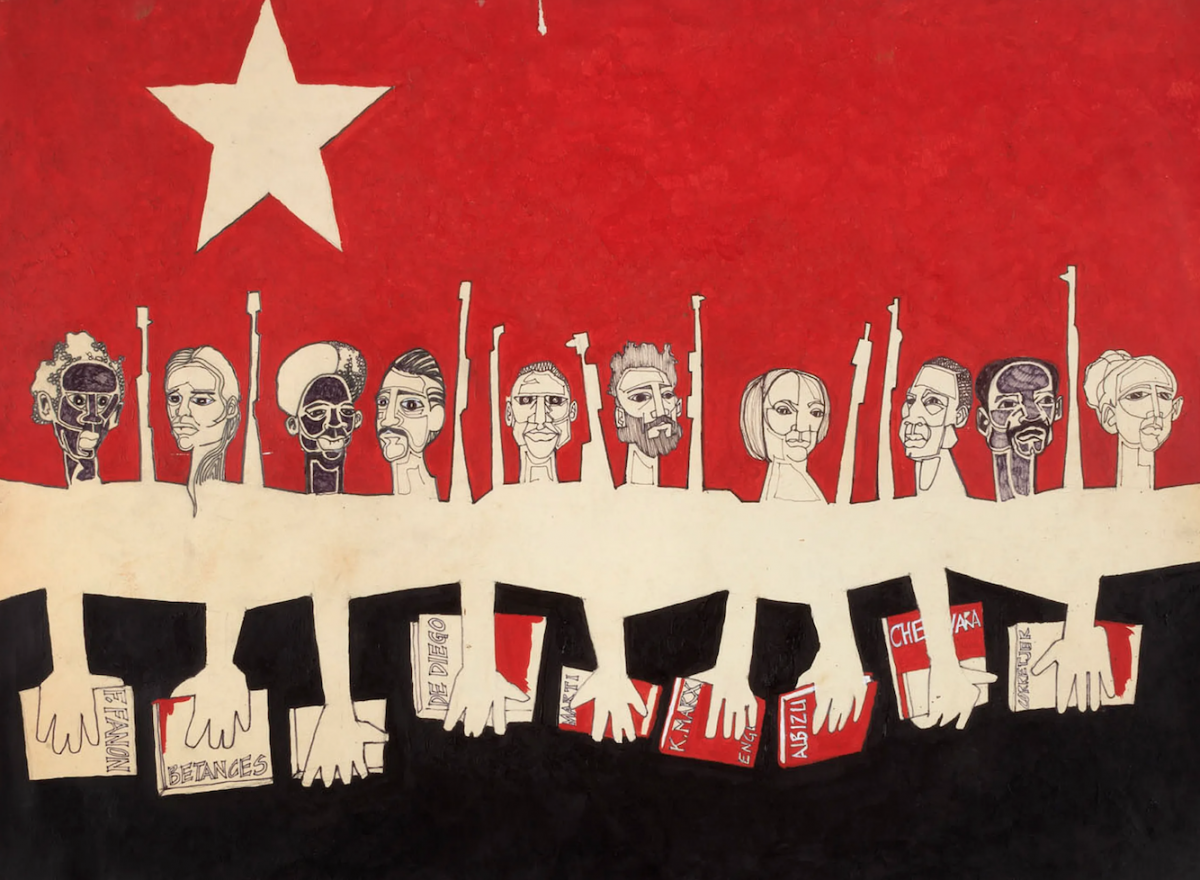
Image from Smithsonian American Art Museum.
Soledad, can you comment on how building connections with other writers influences your writing journey and your poems?
M.S.C.:
Thanks for this question, Adela. I’m always so grateful to talk about the ways in which I think of poetry as community, as imagining the writers and thinkers who have offered space and words to imagine and think through in my own writing.
In some essential ways, I think of my writing life as my reading life—what and who are and have been in my ecosystems of reading. In fact, I often think of my poems as echoes of the writers I’ve read and thinkers, teachers who have not only influenced me but who remind me that my work is not really possible without theirs. I can’t always point to a direct connection, but I know, for example, that when I read Terrance Hayes’s sonnets, I realized in new ways the flexibility and porousness of the sonnet as a form, and that opened up my thinking of the sonnet in my own writing. This rethinking of the sonnet happened again for me very recently when I read Diane Seuss’s sonnets and her more recent Modern Poetry collection. I’m fascinated by persona poems even though I don’t often write them, but between that interest and my reading of Seamus Heaney’s Beowulf, I tried for something with Grendel. And there’s the phrase that inspired the whole poem “Ghosts Don’t Live by Our Rules” that’s from a Viet Thanh Nguyen short story. So in my collection, I really can trace my reading through these poems!
More concrete ways I think about community and poetry are being involved with national and local communities. I’ve belonged to a local poetry workshop in Pittsburgh for many years, and they are often some of my first readers for new poems. I’ve also been fortunate to be part of other groups like CantoMundo and Macondo, and just this year I was lucky enough to be a StoryKnife fellow. And honestly, my students are another kind of community for me. I don’t teach poetry workshops, but I teach poetry, and we talk about it in classes and dream and imagine its power and its grace and strangeness. They often teach me to think about poetry in completely wild and winding ways, which I’m always grateful for.
There are several poems [in Variations in Blue] that have sequences: “The History of Food” sequence that are titled almost the same and then also sequences linked to poetry (“When a Poem Falls from the Sky,” “What Poetry Told Me,” “When Poetry Arrived After Reading Neruda,” and “Volcanic Poetics”). In the food sequence there’s a sense of how food functions to offer sustenance and dreaming or can signal ways we are left dreaming and hungry (I’m thinking of the uses of cream and coffee offering something even in scarcity and then pizza being flat and unfulfilling). I’m seeing connections between the food sequence and the poetry sequence as they connect the ideas of dreaming and being fed along various registers—a mother dreaming while whisking in the first food poem, a mother’s phrases and vowels as a source of food in the poetry sequence, for example. These sequences, I’ll say, are among my favorites in your collection!
Adela, what do the iterative “sequence poems” that echo each other allow you to explore and think about? How did you conceive of these and other sequences in the collection?
A.N.:
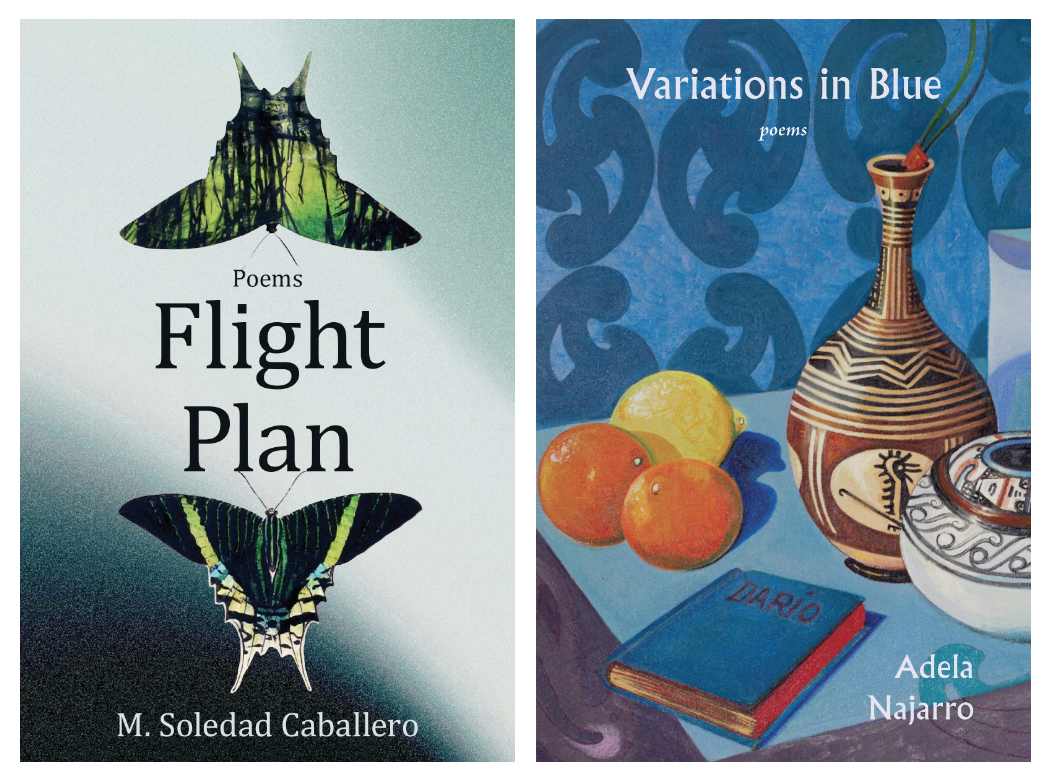
Thank you, Soledad, for your insights into the book. You’ve hit the nail on the head. Variations in Blue is the book’s organizing theme in that all the poems are variations of numerous ideas that echo and weave throughout the collection. The entire book is also a “variation in blue” in that the first section begins with a series of poems that address the displacement of immigration, the second section addresses the devastating effects of domestic violence, while the final section of the book moves toward empowerment and healing. When I was finishing up my MFA, David Wojahn introduced my work as singing the blues, and that idea has stayed with me. In addition, Rubén Darío’s canonical work is Azul. The cover and the title are a wink to that book and Nicaragua’s poetic history.
The idea of writing variations came from a workshop with Juan Felipe Herrera. During the week at the Dos Brujas workshop in New Mexico, I kept showing him my poems, and his refrain was, “Write another one.” I took that literally. I began writing multiple poems on the same subjects, which became the sequences that coalesced in this book. Thank you, Juan Felipe Herrera.
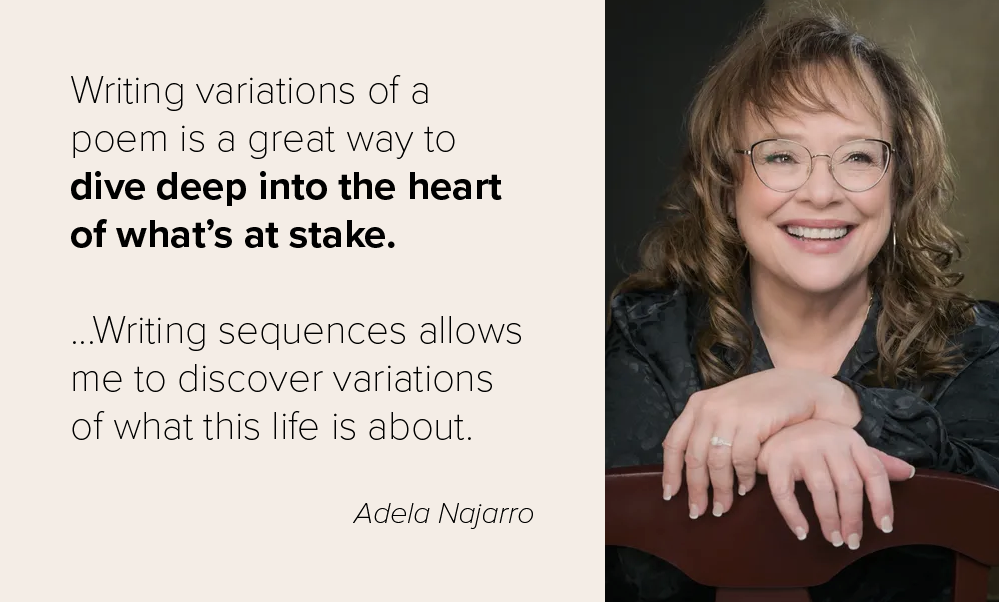
Writing variations of a poem is a great way to dive deep into the heart of what’s at stake. The food sequence expands on the idea that what feeds us is also familial and spiritual. I don’t know if I would have gotten to that idea in just one poem. Writing sequences allows me to discover variations of what this life is about.
A.N.:
I love the title of your book, Flight Plan. It is as though the poems rise above death, trauma, and the perils of immigration into the hope that there is more to our lives than suffering. “Ode to Kody,” “I Continue My Love Affair,” and “Writing Prompt” all include images of birds of prey. Looking at the collection as a whole, it seems that these poems use birds of prey images to discuss the longing for freedom in a world that hunts, breaks bones, and lives “on blood / and entrails, restless for the next flight,” as in “I Continue My Love Affair.”
Soledad, can you discuss how writing about birds of prey allows you to address the challenges and hardships of our lives? What is it about these birds that stimulates your literary imagination?
M.S.C.:
Yes, I have an obsession with birds of prey, and in part it’s tied to the fact that while their health is an indicator of our environment, they are so utterly apart from us in terms of their worlds. I find birds of prey to be able to offer me (and maybe us) a way to stand still and observe a different animal be itself and utterly disconnected from us. My poems about birds of prey try to capture the sense that the nonhum an world is primary and even if completely strange, essential to the world and our capacities to love that which is not for us or about us. In my work, birds of prey are not for me or about me or humans. They are entities of their own that are parallel to our sense of ourselves. I like writing about things that do not feel human-centered. It reminds me about how infinitesimal humans are in the structures and systems of the planet. The challenge to write lovingly and seriously about birds of prey in poems stretches my sense of language and affect. It’s a good exercise in humility and language!
A.N.:
After composing Variations in Blue, I’ve realized that there are always multiple directions to any topic or theme since human experience is so unruly and complex. Obsessions remain the same, questions remain unanswered, and so through new poems, I’ll continue to explore my family history, my connection to Nicaragua, and all the themes in the collection.
In spring 2026, Francisco Aragón, at Letras Latinas, has invited me to visit Notre Dame and begin an ekphrastic project exploring the Raclin Murphy Museum of Art. This time, I’m planning a deep dive into la virgen, mothers, and the spiritual core of our feminine essence. We’ll see what arises from that collaboration with the artists at the Raclin.
Soledad, it was a pleasure to read Flight Plan and chat about the writing life with you.
________________________________________________________
M. Soledad Caballero is a Macondo, CantoMundo, and StoryKnife fellow. Her collection, I Was a Bell won the 2019 Benjamin Saltman poetry prize, was the 2022 International Association of Autoethnography and Narrative Inquiry book of the year, and a 2022 International Latino Book Award winner. Flight Plan, was published in September 2025. Her work has been nominated for several Pushcart prizes and has appeared in the Missouri Review, the Iron Horse Review, the Ninth Letter Review, and other venues. She’s an avid tv watcher, a terrible birder, and teaches at Allegheny College.
Adela Najarro is a poet with a social consciousness who is working on a novel. She serves on the board of directors for Círculo de poetas and Writers and works with the Latine/x community nationwide, promoting the intersection of creative writing and social justice. Her extended family left Nicaragua and arrived in San Francisco during the 1940s; after the fall of the Somoza regime, the last of the family settled in the Los Angeles area. She is the author of four poetry collections: Split Geography, Twice Told Over, My Childrens, and Volcanic Interruptions, a chapbook that includes Janet Trenchard’s artwork. The 2024 Int’l Latino Book Awards designated Volcanic Interruptions as an Honorable Mention in the Juan Felipe Herrera Best Poetry Book Award category. The California Arts Council has recognized her as an established artist for the Central California Region and appointed her as an Individual Artist Fellow.