

The second story classroom is filled with life: seedlings under grow lights, buckets brimming with compost and vibrant posters from social movements past and present. The morning light streams through the old windows overlooking La Doce, aka South 12th Ave. This is Pueblo High School, a legendary Southside institution which has seen generations of Tucsonans walk its halls. I’m packing up books after another session teaching poetry when a student approaches me.
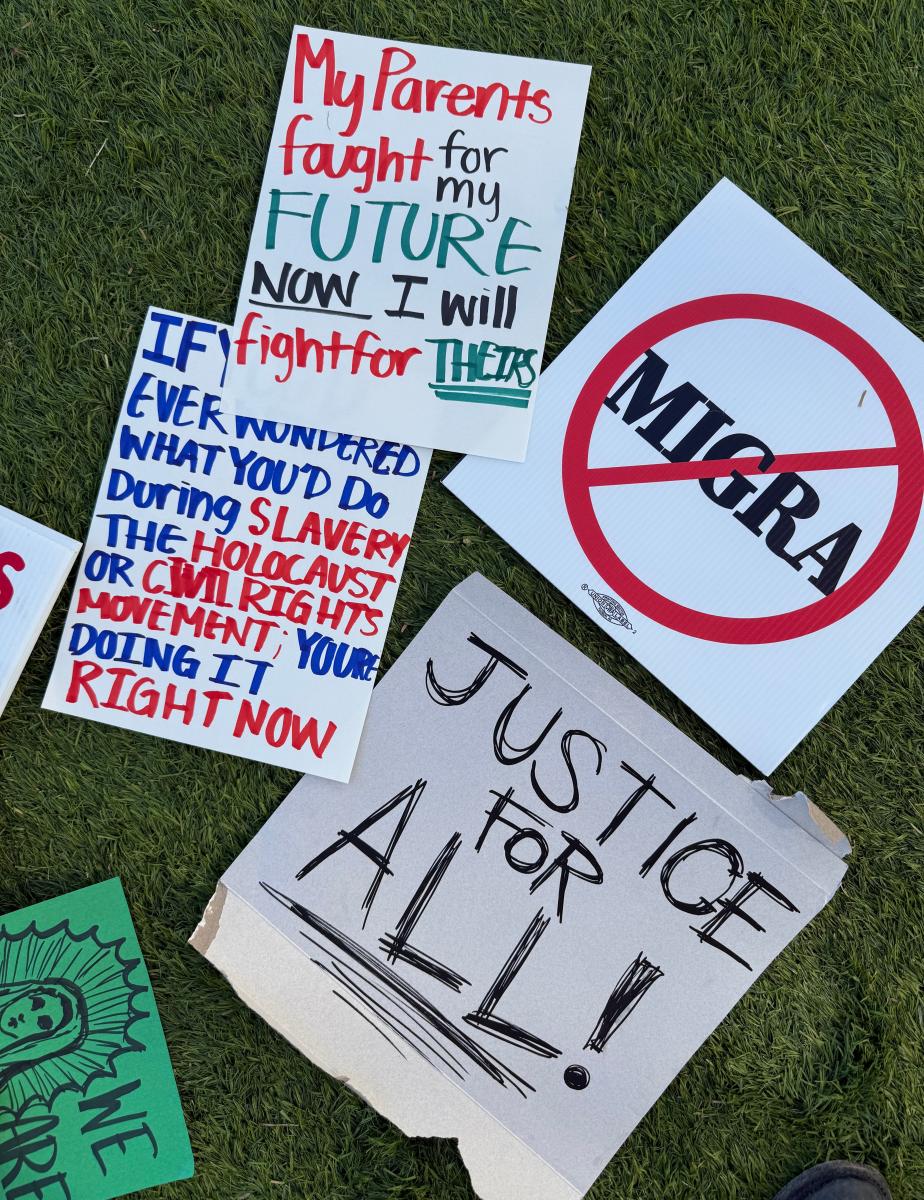 “Hey, I just wanted to let you know that Thursday we’re planning a walkout to protest everything going on,” the student tells me, shifting back and forth on his feet. “It will be after this class, but we wanted to ask if you’d speak at the rally.”
“I’d be honored,” I tell him, “but you’re speaking too, right?”
While the invitation was a surprise, the walkout was not. Fear of raids by masked ICE agents (Immigration and Customs Enforcement) was heavy in the air. In my sessions, students recounted watching violent detentions first-hand and told of family members who no longer felt safe leaving the house. Just days earlier in Minneapolis, an ICE agent had fatally shot Renée Nicole Good, a 37 year-old mother of three, while she attempted to follow officers’ instructions to move her car.
Students were justifiably afraid, and rightfully outraged. Of course they would want to take what action they could, as Pueblo HS has a long tradition of social engagement by students, and has produced generations of Tucson political and cultural leaders such as Dr. Lydia R. Otero, Ernesto Portillo, Jr., Isabel Garcia, Macario Saldate, Raul Aguirre, Socorro Carrizosa and more.
In fact I had seen parts of this history first-hand: some of my earliest Tucson-area afterschool poetry workshops had been held in this very classroom beginning in 2011 alongside fellow teaching artist Sarah Gonzales. We watched stacks of books be taken off the shelves and carted off to storage after the State of Arizona banned Ethnic Studies instruction, and witnessed students’ objections through poetry, art, and direct action – including taking over a Tucson Unified School District board meeting by chaining themselves to the dais.
Now here was a new generation learning the world and fighting for their place in it. The day of the walkout, hundreds of students left their classrooms and gathered in the courtyard before lining both sides of La Doce, chanting as drivers of passing cars cheered them on. When I spoke, I reminded them of the history they were carrying, and also the history they were making: real learning requires that students have agency, and frequently the most important lessons are learned outside the classroom.
Several students spoke that day, and most of them were also writers, learning to use poetry as a bridge towards justice.
 When we gathered the following week for our next session, the students were still buzzing. We watched national news coverage of Pueblo’s walkout contextualized with schools across the United States. We read and listened to a poem by José Olivares, and another from U.S. Poet Laureate Emeritus Juan Felipe Herrera. That poem, “[Let Us Gather in a Flourishing Way],” points to the importance of coming together in times of struggle, and insists on language itself as a site of gathering.
Students conceived of a walkout as a “flourished gathering” and reflected on their experience, using Herrera’s poem as a point of departure. (Here I’m happy to shout out my colleague Julie Swarstad Johnson who has an awesome lesson plan based on this poem).
This is the work of the teaching artist, not only to be grounded in one’s own practice, but to follow students’ lead as events unfold, and continually encourage them to take center stage – right where they should be in any true education process.
Here are a few of the many poems written in the Southside’s morning sun, poems brimming with life:
Freedom
By Alex, After Juan Felipe Herrera
A walkout is a gathering in a flourishing way
Protesting against violence, for justice, for equal rights
For HUMANITY!
WE ARE NOT ANIMALS
We lift out voices where silence once stood,
Each chant a heartbeat – steady and strong,
In every language, every color of skin,
We plant courage and call it belonging.
Freedom is the drumbeat in every street,
The song of elders, children, and dreamers,
Alike,
A culture proud as sunrise,
Refusing to bow to fear or hate.
So we march for the unheard,
Stand tall for the unseen,
Demand respect not just in law,
But in every hand held, every soul recognized.
For justice is more than just a word:
It is the promise of equal rights for every one of us,
A world where dignity is not earned -
But guaranteed.
And when we speak -
We speak for freedom, for peace, for all
I am Joaquin
By Bella Norris, After Rodolfo Gonazles
I am Joaquin I am upset
They have taken my family away
Immigration has taken my family away
Why take my family?
We come here for jobs to try to feed our
Families
We want peace
We don’t cause no harm
We come to find a new life
We aren’t dangerous
We aren’t malicious
We aren’t different
We want peace
Without immigrants there is
No America
A Walkout
by Alexa Tautimez, After Juan Felipe Herrera
A walkout is a gathering in a flourishing way
gathered by injustice and unfairness
the community comes together to stand for justice
to voice for those who cannot speak
A walkout is a gathering in a flourishing way
for the injustice the government stands with
for the immigrants that built us
for my grandparents
A walkout is a gathering in a flourishing way
families of loved ones taken, separated, murdered
Taken cause they're “Aliens”
separated cause they're brown
murdered for standing up
A walkout is a gathering in a flourishing way
as we walk together for our southside community
for the safety of our classmates at Pueblo